
I was accused of being a rigorist last night. I didn’t know this about myself. Simcha Fisher accused me, and a group of other concerned Catholics on Facebook discussing Pope Francis’s ardent defenders, of having this disposition. Apparently that’s what you call Catholics who think that Pope Francis’s words of late have been utterly reckless, theologically misleading, and borderline heretical.
Now, I can’t speak for anyone else, but I’m no rigorist. If anything, I’m a laxist. By nature I am a lazy hedonist. I find the motto, “Eat, drink, and be merry for tomorrow you may die” far, far more appealing than “Turn the other cheek” or anything you find in the Beatitudes. I have no interest in the trite niceties of religion. I struggle to care sufficiently about the poor. I hate praying the Rosary. I’d far rather have an acid tongue than a charitable one. When I read the lives of the Saints, I often think that they sound like impossible caricatures which only mean I am more damned than I ever could have thought, because how could I be that good? I am much more inclined to pursue wine, women, and song than I am the Cardinal virtues. I am a sinner first and foremost, and my selfishness is almost limitless. I have yet to reach a point in my life where my sanctity might inspire the heathen, though I count myself fortunate to know that my words have helped to bring about conversion. Anything that I can count in my favor on Judgment Day, I’ll cling to.
No, I am no rigorist. I am simply a man who needs boundaries, who knows that the (apocryphal) Dostoyevskian adage, “If God is not, then everything is permissible” would apply only too strongly in my own life if I were to try to live without Him.
The Catholic Church was, for the better part of 2,000 years, the one place on Earth where such boundaries were set in stone. So despite my empiricist inclinations and occasional flirtations with atheism, despite my immense struggles with believing in or perceiving a personal God who loves me, I had the law and intellectual tradition of the Church to fall back on. I had Pascal’s wager, much as it always irked me. I have spent many years of my life studying theology, and I have always found comfort in knowing that if I want to know what the Church teaches, I can look it up. Because it’s written down somewhere. Somewhere like this:
 But beyond the words and the laws of theology written in the books were the rubrics of liturgy, sacred art and music, church architecture, adoration, Eucharistic processions – in short, a tapestry of creative genius, pietistic impulse, ritual actions, the collective obeisance to the transcendent through work and worship that is and has been, in point of fact, enough to inspire the heathen. As a little card in my uncle’s bathroom reading rack used to say, “The Catholic Church: Never Popular, Always Attractive.” These things appealed to my aesthetic impulse, to the part of me that seems unable to disbelieve that truth and beauty are two facets of the same gem.
Catholicism was, historically, a magnificent thing. It was grandiose, majestic, and inspiring. It was always greater than the sum of its parts. There is no more profound feeling than entering the Vatican grounds or walking through St. Peter’s Basilica, but for an understanding of the absolutely astonishing peasant faith that built the great European Cathedrals, one needs to look at, for example, the Cathédrale Notre-Dame de Bayeux in Normandy:

This amazing structure, dedicated in 11th century (in the presence of William the Conqueror!) absolutely TOWERS over the surrounding homes and buildings, even to this day. An edifice such as this can be seen for miles, and it tells the visitor that God, not man, is the most important thing to the inhabitants therein. Think of the work, the toil, the craftsmanship of the common that went in to building such a structure year after year until its completion is truly humbling. It speaks of something far greater than one can find in the mere treasures and pleasures of this world.
Catholicism in its greatness was always a religion that inspired and demanded the best from its adherents. It was a “stumbling block to Jews and folly to the Gentiles.” It made protestants uncomfortable by its very nature, its liturgy was steeped in tradition and mysticism, and its armies fought off the Muslim hordes. It brought kings low and made emperors do penance. The traditional burial ceremony of the Hapsburgs gives me chills, when the only entrance to the church that is permitted to those of royal blood is not their impressive list of earthly titles but the statement, “I am a poor mortal and a sinner.”
Belloc said that “the Faith is Europe and Europe is the Faith” because the history of the two — and really, of Western Civilization — were inextricable.
And the Church’s claims on exclusivity left no doubt as to the seriousness of standing outside her gates if one wished to attain salvation. Pope Eugene IV laid this claim on the line in the Council of Florence in 1441, when he proclaimed:
The Most Holy Roman Church firmly believes, professes and preaches that none of those existing outside the Catholic Church, not only pagans, but also Jews, and heretics, and schismatics, can ever be partakers of eternal life, but that they are to go into the eternal fire “which was prepared for the devil, and his angels,” (Mt. 25:41) unless before death they are joined with Her; and that so important is the unity of this Ecclesiastical Body, that only those remaining within this unity can profit from the sacraments of the Church unto salvation, and that they alone can receive an eternal recompense for their fasts, almsdeeds, and other works of Christian piety and duties of a Christian soldier. No one, let his almsgiving be as great as it may, no one, even if he pour out his blood for the Name of Christ, can be saved unless they abide within the bosom and unity of the Catholic Church.
The Church is attractive because she is beautiful. The Church is appealing, despite her many rules and requirements, because she alone claims fullness of truth. The Church is inspiring because she is noble, and her traditions and customs give witness to her profound sacramental beliefs.
Much of this, perhaps even most of this, has been lost since Vatican II. The Church has become an instrument of compromise, of syncretism, and of mediocrity. A bourgeois, bubble gum-chewing religion of suburban good cheer. Her architecture has become banal, her music profane, her liturgies humanistic. She no longer challenges the world with witness to Christ Crucified, but instead tells the world that there are many paths to heaven for people of good conscience.
For the life of me, I can’t fathom why anyone faced with the Church of 2013 would choose to convert to Catholicism. For fellowship? I can get fellowship from the local MegaChurch, with far fewer impositions on my personal liberty. For the sacraments? But most Catholics don’t even believe in the Real Presence, most parishes have no adoration or Eucharistic devotions, most priests offer an hour or less per week of confession time on the parish schedule.
I was drawn to Catholic tradition and the Old Latin Mass not because of some nostalgia, or even a predilection for dead languages. I’ve never taken a day of Latin class in my life and I still don’t understand it. I love traditional liturgy and theology because they mean something. Because they show me my place in the cosmos. Because one can’t help but notice the absolute seriousness and importance of what is going on up at the altar when one isn’t dodging giant puppets and felt banners and Eucharistic ministers and guitar-strumming minstrels and the tinkling of glad tambourines. Because traditional Catholic piety and worship give rise to a feeling that this religion I have been a part of all my life ACTUALLY ACTS AS THOUGH THE COMPLETELY FANTASTIC THINGS IT CLAIMS TO BELIEVE ARE TRUE rather than perpetually undermining its own teachings with watered-down “worship spaces” and infinitely regressing theological nuance.
Catholicism is a “Go big or go home” religion. Catholicism is radical. It is radical in its claims, in its demands, in its beliefs, in its scope, and in its trappings. When it ceases to be radical, the whole enterprise becomes significantly less credible. It becomes merely one choice among many in a spectrum of religions all more or less following the natural law. It ceases to be the fulfillment of a covenant with a chosen people, and instead becomes a lifestyle choice.
So back to Pope Francis. What is my problem with him? Well, let me start by saying that I had hope for the papacy that followed Benedict XVI. I had an inclination that maybe he really knew what he was doing with his abdication and that something was coming that the Church needed. And yet, when I saw Francis that first moment as he stepped out to face the massive crowds in St. Peter’s square, I found myself filled with inexplicable dread. I had no idea who the man was or what he was about – I had never even heard his name before that moment. But there was something in his face, in the deadness of his eyes, that inspired in me a feeling of revulsion. I have always had a strong ability to judge character, but I tried to suppress it. I attempted to find ways to give the benefit of the doubt. I could not discount a successor of St. Peter because of nothing more than a feeling. But that feeling was strong, and I have never been ill-served by listening to my feelings about people.
Then he started speaking. And the statements he has been making are intensely problematic. Are they explicitly heretical? No. Are they dangerously close? Absolutely. What kind of a Christian tells an atheist he has no intention to convert him? That alone should disturb Catholics everywhere. Many of his other statements, by and large, are less egregious, though they are still quite problematic. They are open to wildly varying interpretation because they are made without context, thus leaving it open to the will of the interpreter to apply it. And look at the sort of context one can apply:

Or how about:

Or perhaps:

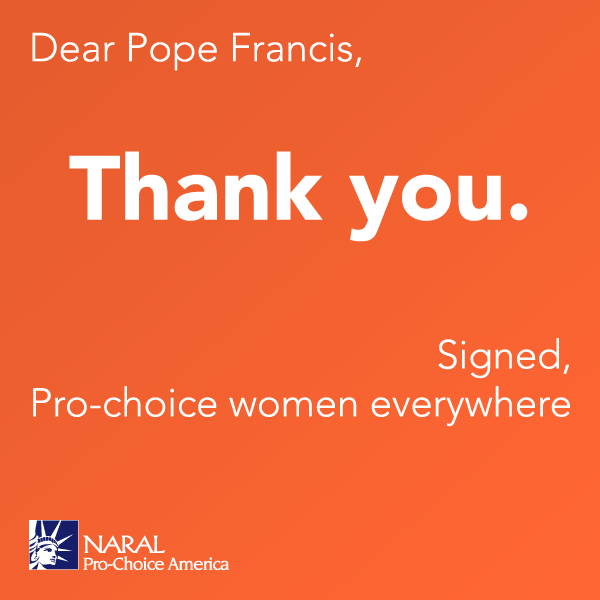
It only takes the barest scraps of creativity and one can apply his words — which on the surface seem simply gentle and eminently reasonable — to whatever situation one wants. Which is why I’m not the only one applying his words to unintended situations. It is the reason why this happened:

In a world where the pope speaks like Eugene IV, or even Benedict XVI, this kind of thing doesn’t happen. A pope who knows Catholic doctrine and hews close to it in his public statements does not provide opportunities to be co-opted by some of the most evil people on the face of the planet. You want to blame NARAL? Go right ahead. But he’s the one who said we talk too much about abortion. And when you combine that with statements about the greatest evils in the world being unemployment or the loneliness of the old, I can’t see why they wouldn’t thank him. It’s a dream come true for them. They were on their heels, and the greatest single point of opposition to abortion in the world — the papacy — just decided to let up when momentum was finally building.
There are a lot of Catholics out there – good ones, probably far better ones than I am – trying to put a positive spin on every foolish thing the pope says. They don’t like it, not one bit, when other Catholics say things like, “Hey, what this guy is saying doesn’t sound at all like the Catholicism I’ve lived and studied MY ENTIRE LIFE. It sounds like something far different. It sounds like something intended to change the way Catholics believe.”
I can’t say I blame them. It’s tough when you find out that the pope isn’t doing things in the best interest of the Church. I remember how I felt when I first discovered that during my study of the Second Vatican Council and the subsequent liturgical revolution. I was a JPII-We-Love-You Catholic with my BA in Theology from Steubenville, of all places, and a life spent in the Novus Ordo Missae. I wanted to find the flaws in the traditionalists’ arguments, because I couldn’t wrap my mind around what they would mean for the Church. Instead, I found myself agreeing and then ultimately joining their cause. C’est la vie.
I don’t think Pope Francis’ defenders are insincere. I don’t think they’re saying these things just because they want to continue their working relationships with the mainstream Catholic publications they write for. Working for the Church, in whatever capacity, is one of the quickest paths to financial insolvency, and it’s hard to lose that income. I’m glad I don’t depend on my Catholic writing gigs, because I’m finding it very hard to publish anything positive about the Church right now. But that doesn’t make them opportunists.
I like Simcha Fisher. I think she’s a good person and a faithful daughter of the Church. She has a lot of kids and she’s trying to raise them right and she is, often as not, more sensible than many others when it comes to her take on issues in the Church. Hell, I’ve sided with her on more than one occasion. Even on the issue of (gasp!) women wearing pants!
I don’t have any ill-will for Catholics defending the pope, but I do wish they would stop already. He is doing a lot of damage. He is muddying the already unclear theological waters and making it very, very easy for a world hell bent on seeing Catholics as the bad guys to misinterpret things until we have no chance of having an honest conversation about anything anymore. They’re already using “but the pope said” arguments against people out there defending the unborn and arguing against gay marriage. It isn’t going to stop. So while there may not be malice at work, I think these papal apologists need to step back and ask themselves if they’re maybe, just maybe, being a bit willfully obtuse.
Not all popes are chosen by the Holy Spirit, folks. Not everything a pope says is infallible, either. Heck, most of it isn’t. It’s OK to distance yourself from a dangerous pope. You don’t need to keep saying that things he said or did are being taken out of context, or that he didn’t contradict doctrine. The pope is not the faith. Eastern Catholics have been getting along fine without much input from him for millennia.
History shows us the truth of this. Pope Stephen VI wasn’t taken out of context when he held the cadaver synod. Pope John XII wasn’t misunderstood when he was committing adultery and murder. Pope Urban VI wasn’t being taken advantage of by the media when he tortured members of his curia who opposed him.
And none of these popes contradicted doctrine. They were all real popes. Valid popes. They were all protected by the Holy Spirit from promulgating doctrinal error in an official capacity, and that guarantee worked out just fine. But they were all asshole popes. Terrible, lecherous, murderous people. May God have mercy on their souls.
The thing they couldn’t do that Pope Francis can do? Give interviews that can be read by a global audience. Talk about doctrine in a non-doctrinal capacity in a way that gets everyone all confused. You can argue that they were worse while they were bedding women and killing enemies and digging up the corpses of their predecessors, but I honestly find that a lot easier to deal with. Nothing like, as Nancy Pelosi likes to say, a “Wolf in wolf’s clothing.” I like an enemy I can see.
No, what’s worse is when the enemy speaks in half-truths. When they veil themselves in cryptic language that can be taken to mean one thing by the orthodox and another by the progressive. When they speak in code that tells their brothers in the revolution that the fight is still on, that the 1960s aren’t dead yet and getting better. When they say nothing at all that can be definitively denounced as heterodox but everything that can be embraced by the heterodox if they so choose.
Stalin had a word for the people who sympathized with the Soviets in the West: useful idiots. This papacy is looking to be a continuation of the revolution that began before Bl. John XXIII invoked the council. This is a battle for the soul of the Church that is happening within the boundaries of papal infallibility, but make no mistake – a lot can go wrong without changing a single doctrine.
If you love Catholicism, take some time to read up on what it teaches. Or, I should say, what it taught before the second half of the 20th century. Understand the continuity that existed between popes in the past, and compare that to what you’re seeing now. You might be surprised.
If you want, in charity, to give Pope Francis the benefit of the doubt, you have every right to do so. But I urge you to ask for discernment. To question with boldness whether your benevolent papism — an entirely noble but ultimately unnecessary aspect of the life of faith — is enabling something that will damage the Church’s ability to evangelize for years to come.
UPDATE 11/10/13: If you are arriving through various links, or the New York Times article itself, I have written a followup to this post that helps answer some of the questions that have arisen in the comments.
Comment formatting seems wonky. Looking for a fix. If you’re wanting to post a comment and can’t figure out how to submit it, hit the “tab” button on your keyboard and it should move you to the area where you can hit “post comment”.
Mercy, and more mercy, love and acceptance of all on this earth…
and I do believe firmly, we are not to judge….we are to live in love and mercy and grace..
Conservatism in any church scares me..as if conservatives are trying to push for/achieve their idea of perfection in individuals…and none of us are perfect…leave the “controlling” conservatism ..it becomes its own kind of sinful life…..live with mercy, love and grace
I agree
Be judgmental…..annoy liberals
“You were hungry and thirsty
So I eliminated meals on wheels and food banks .
You were a stranger so I vilified You and demanded that You be deported.
You were naked so I called you an evil Liberal who hates conservative family values .
You were sick so I repealed your only hope for healthcare .
You were in prison so I tortured you.” Jesus according to The Conservative Bible
Not i will stick with obedience to the Will of Christ
JMJ
DA, you are completely wrong about conservatism in the Holy Catholic Church, or, for that matter, anywhere else, such as politics.
Conservatism attempts to conserve that which is proven and rejects the flights of fancy of modern liberalism. Only that.
Your idea that conservatism wants to “push for/achieve their [sic] idea of perfection in individuals” has no basis in conservatism. Can you explain where and how you got that idea? It would be interesting to hear.
I’m more concerned about jackasses like you!
The only good conservtive is a dead conservative. Thank science for the 2nd amendment!
http://lyricstranslate.com/en/baby-one-more-time-krikh%D1%96tko-shche-raz-kryhitko-shche-raz.html#ixzz3pdHl2QFk
О крихітко, крихітко
О крихітко, крихітко
О крихітко, крихітко
Звідки я могла знати
Що щось тут було не так
О крихітко, крихітко
Мені не варто було відпускати тебе
А зараз тобі не вистачає натяків, так
Покажи мені, як ти хочеш, щоб воно було
Скажи мені, крихітко
Бо я хочу знати зараз, що ми маємо
What a strange comment, Tony. Why would you post the lyrics to Britney Spears’ “Baby One More Time” as a comment…in cyrillic? Bizarre.
Comments are working for me, folks. The only thing is that the fields are hidden below the footer until you tab over. Still trying to figure out where that formatting is hidden. I apologize to those of you who have tried and been unable to leave a comment.
You raise some good points. There’s a lot of confusion being spread. Perhaps Pope Francis should just stop doing interviews and instead make statements based on prepared written speeches, where he’s less likely to say something wrong because the wording can be carefully weighed and vetted in advance.
On proselytism, I’d just like to point out that even Pope Benedict spoke against it in his encyclical “Deus Caritas Est”. Why? Because in Vatican parlance, proselytism is not a synonym of evangelization but rather means coerced conversion. Here’s what Benedict wrote:
Even Pope Benedict spoke against proselytism in Deus Caritas Est:
“Charity, furthermore, cannot be used as a means of engaging in what is nowadays considered proselytism. Love is free; it is not practised as a way of achieving other ends. But this does not mean that charitable activity must somehow leave God and Christ aside. For it is always concerned with the whole man. Often the deepest cause of suffering is the very absence of God. Those who practise charity in the Church’s name will never seek to impose the Church’s faith upon others. They realize that a pure and generous love is the best witness to the God in whom we believe and by whom we are driven to love. A Christian knows when it is time to speak of God and when it is better to say nothing and to let love alone speak. He knows that God is love (cf. 1 Jn 4:8) and that God’s presence is felt at the very time when the only thing we do is to love.”
Squeaker, if you look at the context, the Pope and the interviewer were clearly talking about evangelizing, not coercion. Obviously the pope did not need to assure the interviewer that he wasn’t there to forcible coerce him into Christianity – it’s clear that they were both talking about the act of convincing a person to convert, not forcible coercion. Denying the plainness of this is borderline denial.
How will an ill atheist will know that you are serving him for the love of Christ if you will not tell him that Christ has commanded that you love him as you love yourself? Certainly telling him about Christ while doing him good is better than telling him nothing.
Did Jesus want us to promote a belief system? Or to love one another? To perhaps do good and not even be found out?
He wanted us to promote the Truth of Teaching, so yes a belief system… Upon this Rock I will build my Church did you miss that part…wait you must be liberal
“You were hungry and thirsty
So I eliminated meals on wheels and food banks .
You were a stranger so I vilified You and demanded that You be deported.
You were naked so I called you an evil Liberal who hates conservative family values .
You were sick so I repealed your only hope for healthcare .
You were in prison so I tortured you.” How conservatives (mis)interprete Jesus!
Are you unaware that Benedict XVI also condemned proselytism? Francis is the true successor of Benedict XVI,
http://mostholyfamilymonastery.com/benedict_xvi_apostasy/benedict_xvi_address_bishop_conference_senegal_february_2006.php
Well, this is wonderful! I got here via Dale Price’s link. I’ve been thrashing out a lot of the bad wackiness involved in all this. Dale’s even called me his “crisis buddy” heheh. http://ebougis.wordpress.com/2013/10/06/this-isnt-denzinger/
Thanks, Codgitator. I read your post with interest. It’s a strange time, isn’t it?
Hey Steve. It’s been a while. 🙂
Just to devil’s advocate for a bit… what do you think is the greatest long-term negative to Francis’ m.o.?
Hi Chris,
I think the greatest long-term negative is, as I said, the further muddying of the waters about what the Church teaches. Whether it’s bringing people into the Church (or into consideration of the Church) not because they suddenly find it attractive but because they think the Church has changed its stance on issues to which they are diametrically opposed, or if it’s the scandalizing of those who have worked long and hard on the issues he says the Church is too obsessed with, or if it’s simply that long-settled doctrine seems fuzzy now in ways that we’ll be spending many years explaining, it’s all part and parcel to the boundary-pushing vagueries of his style.
I’m already having his words thrown back in my face, even when people are clearly taking them to mean things the Church doesn’t teach. This complicates our mission to evangelize and teach the faith. He seems to be favored by men like Cardinal Kasper, who deny that we should be pursuing an ecumenism of return, and his own words about proselytism and conscience-following and the idea that there is no Catholic God seem to bear that out.
The other thing I think he’s doing is deconstructing the power structure of the magisterium. And he’s effectively dividing the house against itself. So much Catholic infighting. I’m seeing the re-invigoration of the whole “spirit of Vatican II” thing all over again.
“I’m already having his words thrown back in my face, even when people are clearly taking them to mean things the Church doesn’t teach. This complicates our mission to evangelize and teach the faith.”
Steve, can you give a scenario — hypothetical or real — in which Francis’ words lead someone who might’ve been otherwise open to the Church to reconsider? Francis’ words certainly have made it more difficult in some cases to *argue* for the faith, but that’s not necessarily the same thing.
Thoughts?
I’m sure there are any number of people who left the Church over the “pelvic issues” that think he’s changing Church teaching on those things and thus, reconsidering. Not because they are moving toward the truth, but because they think the Church is moving toward *them*.
Unfortunately these are false pretenses. I can’t imagine anyone being willing to give the Church a second look because Pope Francis is calling attention to the beauty and necessity of the sacraments, or the efficacy of Christ’s passion, or the necessity of membership for salvation, or anything that matters. They might like that he doesn’t want to convert them. They might like that he seems to be loosening the rules. They might like that he feels solidarity with labor movements or the unemployed. They might think it’s cool that he drives a beater and hangs out with the poor.
But none of those things are reasons to become Catholic. The same “hard sayings” still apply that keep people away.
On the flip side, telling people that all they really need to do is follow their conscience to be good, that there is no Catholic God, that he has no desire to convert an atheist, etc., all speak to a sort of syncretism — an “all paths lead to heaven” kind of anti-ecumenism. It negates the idea, however you want to nuance it, of “Extra Ecclesiam Nulla Salus” and the urgency to lead people to truth that comes with a real love of souls.
Paix à vous,frère en Yahvé-Dieu,je Vous suggère Fortement de lire sur MyriamirWordpress.com,ce qui circule dans 200 Pays,en 40 langues “L’Avertissement”,
et je crois que vous comprendrez Le pourquoi de la “façon de faire”,de ce Vicaire du Christ,bien (détaillée),dans Apoc. de Jean,et les Messages de La Mère de l’Église (Corps Mystique de Jésus-Christ) Marie-Reine du Monde,dans Ses Messages depuis Fatima,jusqu’à Medjugorje en ce moment encore+++
le perroquet+++
Que le Seigneur de l’Ancienne et de la Nouvelle Alliance,vous bénisse,ainsi que tous les humains,sur la terre qu’Il a BÉNI+++
Jesus didn’t care two hoots about the dead dogmas and empty rituals of the rabbis, from what I can tell. Neither do I. Jesus din’t command us to be Catholic. We’re commanded to love one another and to minister to the sick. Its not about “the church moving towards me” or “me moving towards the church”. Its not even about me moving towards Christ. Its us opening ourselves with loving hearts to one another, as he taught us to do. Thats what I hear Francis saying.
Pope Francis = a wolf in shepherd’s clothing?
Well-played, sir. Well-played.
Conservative catholics = taliban?
Such an equation is defamatory. The Taliban, domestic Islamic fundamentalists are terrorists. They are the very definition of intolerance. The Taliban forces compliance at the point of a gun. “Forgiveness” is not in their vocabulary. OTOH, orthodox Catholics (“conservative” being a political term) lead and form their families in the Faith, encourage faithfulness in the rest of the world by their example, decry violence, and pray publicly (e.g., at abortion mills) for others’ conversions of heart.
Sen Sei = troll?
Steve Skojec = heretic?
Feel free to make your case.
Your written word speaks for itself.
Wow. What a cop-out. You’re in my house, so you don’t get a free pass on that. Show me the heresy in *anything* that I’ve said. Seriously. Anything. I won’t expect you back any time soon because you’ll be spending a while hitting the books.
Thank you! The attempts to square the myriad Fraciscan circles are beyond tiring. The worst are the cheers of “What a great opportunity for evangelization he’s afforded for us!” Seriously? Having the Pope’s own words thrown back in our faces – when we try to express the Church’s moral teaching – is helping evangelization, how, precisely?
And thanks also to Steven Alvey. I heard Al Kresta trot out the coersion explanation for what the Pope meant by proselytism. What rot. The context was clearly about one person simply trying to persuade another to convert.
Most people understand proselytism to be synonymous with evangelization, if with a slightly more zealous ring to it. But when you have the pope saying that God is not a Catholic God and that he has no intention to convert an atheist, it’s hard to think that he’s just talking about coercive methods.
I’m almost afraid to publicly admit that I agree wholeheartedly. With this entire article and your responses here. I feel like I have to duck and run for cover at the mere suggestion that he might be doing some harm here…..
Heh! Tell me all about it. –> The F1 F/X Files.
Good;
Speaking as an atheist myself, a lot of us would appreciate it if you guys would just enjoy your faith and quit trying to “convert” us. Really, we’ve heard the message and it’s really not for us.
Thanks,
Enjoy your Church.
Jeff, we are sincere in our belief that the fullness of truth resides in the Catholic Church, and follow Jesus Christ’s instruction to proclaim the gospel to “all nations.” Jesus intends that all men hear the “good news of salvation.” We would be hypocrites if we ceased to proclaim the Faith to all within earshot. However, it is not we who “convert” you. The Holy Name of “Jesus” has the power, in itself, to turn the hardest of hearts. So, be careful! Just reading these words, you have placed *yourself* in the middle of this fragrant Christian garden and risk being picked … by Him.
Patricia Gallagher, I am not an atheist, but I disagree–I think that it damages Jesus’ cause when people simply parrot the name like a mantra, over and over, expecting it to “turn the hardest of hearts.”
It’s thoughtless, not to mention arrogant (since it presumes “only my own faith is correct,” which, you’ll note, is exactly what a proselytizing Muslim, Jew, or buddhist would think if they did the same thing–the atheist above has heard all the names of Jesus, Moses, and Mohammed and buddha, but feels in his heart and mind that it’s not for him). To continually pound and pound at the guy, just repeating the name Jesus over and over, or saying “only Jesus will save your soul” without considering the fact that the man has heard all this before, is simply… well they say the definition of insanity is doing the same thing over and over and expecting a different result.
This sort of behavior turns people with brains AGAINST the Church, it doesn’t convert anyone except the easily browbeaten, who aren’t worth much to the Church anyway.
Best comment so far.
Yes, evangelists (i.e., all baptized Christians) must respect the state of receptivity of the hearer(s).
Jesus claims the church as his own (Mt 16:18) and calls Christians to the work of evangelization (Mt 28:19, Mk 16:15, Luke 24:47, Acts 1-2).
Atheists do not understand the Church’s mission, the exact opposite of which is to “just enjoy [our] faith and quit trying to ‘convert’ [atheists].”
Catholics have no power of their own to convert hearts. That is the work of the Holy Spirit. Hearing the Holy Name of Jesus, alone, just once, has the power to change hearts. Many Christians repeat it in prayer. (“Parroting”?)
Regarding the fact that the fullness of truth resides in the Catholic Church, your quarrel is with Jesus, “the way, the truth, and the life” (John 14:6), who directed His Church proclaim that message.
Well, a Protestant could argue that you are actually the one quarreling with Jesus on that passage, for you would add your own clergymen and Pope to the passage, saying that “the way, the truth, and the life” are found through Jesus, those clergymen, and the sacrament, whereas a Protestant only stipulates Jesus alone. I think you will come off as arrogant even to Christians if you insist that only your own branch of the faith bears “the fullness of truth.” I believe that you are not God, so you cannot declare that.
The Catholic Church was founded by Christ and is His Mystical Body. As such, she possesses the fullness of truth. Protestant communities (over 30,000 and counting) were founded by men. They can only offer part of the truth.
The theological and historical support for these statements is readily available. Anyone who disputes this does not know history.
Jesus alone is the world’s salvation. He has the power to save souls who have not *heard*, and thus cannot have *rejected*, the Gospel. How God accomplishes this is a mystery.
To declare these things to be indisputably true, you would have to be God, and I believe that you are not God, nor do I accept your dictation to me as to what is absolute truth and what is not. I do not declare my own view of the bible to be the undisputed truth, and I believe that if you do, you are attempting to make yourself God. You and bill lawrence are fighting for the same throne, in that case.
Actually, Steve when it comes to the religious stuff I’ll defer to the Pope. How about you? Or do you want to go sola scriptura?
BTW, where do you think life starts? Are you OK with late term abortions? Early term abortions?
I apologize. I read this as coming from the wrong person. I certainly got under your skin Andrew. At least hopefully, I’m making you think. I saw where you are now claiming than an embryo is no different than sperm and the cellular debris of menses combined. Keep practicing with the thinking.
Um… hey, bill? I know you want to force it to be true that you’re “getting under my skin” (as earlier, when you claimed “I detect emotion!”). Unfortunately, I’m not showing “emotion” when I say to Patricia that you think you’re God, and the possessor and dictator of what’s true or not. I’m mocking you. That’s something a little different. Can you endure it?
As I said to you below, you’re going to anoint yourself Completely Right about Everything, no matter what anyone says, even if Jesus Christ comes in disguise (or unexpectedly, “as a thief in the night”) and says it to you Himself. Therefore, you are deaf, and have no ears to hear anything from ANYONE. That is why I let you have the last word below.
Sorry to have mentioned your name; I will avoid doing so, so you have no further occasion to lie about the significance of it. Have a nice life, Your Unerring Lordship.
I do believe Andrew is that it was because you couldn’t answer my questions.
Do you think someone should be allowed to kill just because they are depressed?
Do you think we should be allowed to kill kids with Down syndrome?
Yes, bill, you believe many things, and you seem very certain that you are infallible in your beliefs. That is why I let you have the last word, as you’re not listening to anyone but yourself, not even to Jesus. Therefore, it has proved a waste of energy answering you, since your answer at the end of any conversation, as at the beginning, will be to anoint and announce yourself perfect. Have fun congratulating yourself on that, OK? bye-bye now.
You sure read a lot of things into what wasn’t said. I haven’t gone into a lot of detail as to what I believe and in what little I did I was consistent. I certainly didn’t claim that life begins at viability then switch to a claim that it starts with the first breath. I certainly wasn’t, well, judgmental.
I did ask several questions, however, and asked you to explain your reasoning for your flavor of the moment belief as to the start of life. You declined to do so.
If life should begin at conception — i.e. that you are terribly wrong — would you regret not having defended it?
(Sigh) I did NOT switch (please ask first, if you are confused, before bearing false witness). I said clearly that I agreed with the law of the land, which is that abortion is acceptable until viability, except in cases of grave birth defects, or grave medical conditions of the mother (though you did remind me, and thank you, about the “grave birth defects” part of the equation, which my posts hadn’t mentioned). For the last time, I do not know how much clearer I can make that, since you are not listening.
The reason I agree with the law of the land, that abortion is acceptable until viability, is precisely _because_ I believe that life begins at the first breath; ergo, since there is no possibility of the first breath occurring UNTIL viability, it makes no sense to me to ban abortion until viability. I’m quite out of breath saying these things to someone who has no ears to hear anyone but himself; but capisce? Or no?
If it turns out that I am wrong, and that Jesus considers abortion to be a horrid murder after the first second of conception, will I regret holding this opinion that is wrong? Yes, of course. If it turns out that YOU are wrong, and that Jesus says instead “Andrew was right, and moreover, when you and President Santorum banned abortion, you increased the misery of THOUSANDS of my children. Not just the babies born with severe birth defects to parents who knew they couldn’t care for them properly, but also couldn’t get contraception because you prevented them from getting any, but the mothers-to-be who went back to the back-alley abortionists, and died of septic shock; their husbands and boyfriends, their brothers and sisters, their mothers and fathers and grandparents, and all the parishioners and neighbors who will miss them for the rest of their lives”? If it turns out that your deafness to any word of mercy, to any word at all outside of your own head, means that you are increasing the misery of these children, and that Jesus Christ finds you wanting because of it? What say YOU about that?
If your standard is first breath then you would have no moral problem with an abortion after 30 weeks, much less 20, regardless of the reason. Is that what you believe? In fact, you would have no problem killing the child just as long as the head remained in the birth canal. Is that what you believe?
More significantly, you never explained why you believe this. Every scientific, objective test as to the start of a new life points to conception. In your pride, and in your comfort on the broad path to the wide gate, you cannot consider this.
Regarding my facing God on Judgment Day, if He should turn around and say murder for convenience was not just OK but that He wanted it done, I guess I would have been worshiping the wrong god. Right?
I think the appropriate verse you ought to be consider is “Do not deceive yourselves. If any of you think you are wise by the standards of this age, you should become “fools” so that you may become wise.”
Oh, and this is rich; please compare your two statements to each other:
“I certainly wasn’t, well, judgmental.
I … asked you to explain your reasoning for your flavor of the moment belief”
You are claiming with a straight face that calling my beliefs “flavor of the moment” is not judgmental, or that you’re not inwardly preening with the thought that “MY [bill lawrence’s] beliefs, on the other hand, are NOT flavor of the moment”?
Please. That sort of thing is the reason that I have said “you lie,” though that certainly is judgmental too. Pretty clear that you were making a judgment about my belief, if you want to be honest about it.
And may I ask? Since 1) you know that I’ve said SEVERAL times, in essence: “I’ll let you have the last word now, since you’re not listening to anyone but yourself, so have fun announcing your own beliefs to an echo chamber”; and 2) if you’re so certain that God thinks all your cherished beliefs are righter than my cherished beliefs are; then why, oh why, on God’s previously-green earth are you so urgently desperate to try to get me to keep mentioning my beliefs?
Look at everything I wrote and cut and paste the phrase where I was “judgmental”. Consider it a challenge. Now, you’ve admitted you’ve mocked, you’ve admitted you were judgmental and you’ve called me a “liar” even though you perversely agreed I told the truth — that clinic in Colorado performs late term abortions for reasons other than to save a mother’s life and due to the subjectivity of the mental health exception one suspects it will perform them for any reason excepting shortage of money — making you a bearer of false witness, so why do you even bother calling yourself a Christian?
Regarding why I want you to explain your beliefs has to do with has to do with the reality that life objectively starts somewhere and those who defend abortion seek to place a conveniently subjective rather than objective definition on this point. So defend your belief that life starts with the first breath.
I made a long post, but it apparently didn’t take.
I have been pretty clear about the fact that my beliefs as to when life starts are as subjective as yours are, and are just as much a matter of faith as yours are. You don’t like that, and continue to thumb the scales to try to insist that I must be wrong about my spiritual beliefs when they conflict with yours–I simply must be!
I have never said so to you; I have said clearly that I understand that you have a heartfelt belief that is different from mine, so–believe it, if you’re moved to! Feel free. After all, as I’ve also made clear, I believe that ALL of us are wrong about HUNDREDS of our spiritual beliefs. You “must have been worshiping the wrong God” if you prove wrong about hundreds of your spiritual beliefs, you think? I doubt it, considering that it is in our nature to be wrong about HUNDREDS of the things we’re most certain of.
If you’re unwilling to allow the same of me, that it is possible that what I believe through my own faith is correct, and so certain that it is impossible that you’ll be wrong in that way, then shove me out of the way at judgment day, and say “it’s okay, Jesus! I should be put first, don’t you think, since I am so all-fired, blessed in-the-Right?” For my part, I believe that Jesus will sooner say “sorry, Andrew–would you like me to list the HUNDREDS of points on which you felt so certain, but were so wrong?” than “hey! Good job, Andrew–you weren’t wrong about ANY of the spiritual beliefs you were certain of!” and that He’ll say the same thing to you, Patricia, Steve, and EVERY one of us. We are GUARANTEED to be wrong about a LOT of them, in my opinion, and that says not at all of an all-or-nothing “then we must have believed in the wrong God” leap of illogic.
If you believe you are that infallible, though, then you are either making yourself God, in which case it’s a waste of breath to talk to you; or you’re right, and you actually ARE the infallible God, or have a direct line to God’s Truth, in which case it’s blasphemy for me to disagree with you any longer. Please be well, and have a great life.
You are very wrong in your belief that the start of life is something that is subjective. Life starts somewhere and the point at which it starts will be the same for me as it is for you. This can’t be denied. This is not something about which you can hand wave away. This is not something that you can dismiss as a difference of opinion. This is a reality, and it’s not a spiritual belief. It’s a matter of nature.
I quite admit the possibility of being wrong that life starts at conception. I can explain why it is that I believe this, however. It is not blind acceptance of religious dogma. It is the result of self-argument and much thought that led to the conclusion that conception is the most logically consistent and reasonable view as to where a new life begins. Feel free to assail albeit without name calling.
Now you believe that life starts with first breath. Why do you believe this?
Again to make it clear: this is a discussion about nature not spiritual matters, and there is no claim to “infallibility”.
As a Catholic from India who has both Hindu and Christian parentage, I do have an issue with forced conversion that some missionaries engage in. I used to believe in spreading the Gospel when I was young, but over the years have had a change of heart. Of course, everyone in India appreciates the amazing work they do of providing schooling or nursing care for the poor and under-privileged. No one doubts that. However, some of them offer food (it is commonly known as ricebowl conversion) only if they agree to listen to the Gospel and are given further incentives after conversion. Then in their discourses, Hinduism is ridiculed (multiple gods, cow worship etc.) and poor folks are lectured until some of them agree to convert and be saved. Hindus feel that some missionaries have an objective to convert and not really feed the hungry and they can never understand why missionaries are bent on converting Hindus when they just want to live out their life which is tough enough in a poverty-stricken place like India
Yes, indeed.
Exactly right!
Jeff, welcome to the blog. Perhaps you could direct us to your blog. I am always interested in why people make the choices they do. As to people sharing their faith, well…it’s like finding a great restaurant, if one is generous, they like to share the feast!
Enjoy your life and may you find happiness.
In other words, “What kind of a Christian tells an atheist he has no intention to convert him?” The kind who’s not a jerk.
How do you figure? If you believe something is true, and that it benefits others, do you keep that to yourself or do you share it? Because in my mind, it’s pretty damned jerky NOT to share something good with others.
I’m not saying he needed to beat him over the head with it. But making it clear that he had no intention of doing it seems a pretty big failure to do his job, which is pretty uniquely involved with the business of spreading Christianity.
I agree we shouldn’t be trying to “convert” you i.e. manipulate you somehow into belief. There is an obligation, however, to witness to you and to make try to make you see things such as that there is a point to your existence and that point is not something that is self-determined.
Convert = Manipulate? What would be the point?!
Manipulation is “a type of social influence that aims to change the perception or behavior of others through underhanded, deceptive, or even abusive tactics. By advancing the interests of the manipulator, often at another’s expense, such methods could be considered exploitative, abusive, devious and deceptive. … Depending on the context and motivations, social influence may constitute underhanded manipulation.” [SOURCE: Ask.com]
Let’s leave the negative aspects of the Crusades or the Inquisition (esp. the renegade Spanish version) aside and keep this discussion in the present.
Bill is correct in this: Personal witness, example, and formal instruction of those willing to consider the truth of Christianity, are methods of “conversion” (a word out of favor in recent decades).
I’ve pursued training and participated in evangelization to Catholics and non-Catholics alike. As an adult team member for RCIA (Rite of Christian Initiation for Adults), and in courses and written materials of the Catherine of Siena Institute [siena.org], I’ve never been instructed to use manipulation, coercion, exploitation, or deception to persuade another person of the truth of Catholicism/Christianity.
Some people think that “convert” means you are going to change them into some kind of a pod person. I just want to make it clear that that is nobody’s intent and that’s not what happens.
You wrote what I have been thinking. Thanks for helping get my thoughts together. God bless
Thanks, Alex. Glad I could help.
Yes, help each other maintain the epistemic closure.
Right, and long after the “joke” about trying to convert each other, when the conversation had taken on a deeper, more ideological tone, Scalfari basically asks, seemingly in earnest, “Hey, I thought you said you weren’t going to try to convert me,” and the Pope replies, “I have no such intention.” O_o The Catholic Pope, guided of course by the CATHOLIC God (ahem), doesn’t even intend to TRY to convert an atheist more on the verge of death than not? What a world. My astonishment and displeasure with “our Jesuit Pope” continues as my blog, if anyone is interested. (that wasn’t a shameless elf-promotion –> My faith is feeling a bit rattled by him, so I’d appreciate constructive input.)
Dear Steve,
I am a student at a faithfully Catholic college (Aquinas College – Nashville, TN) operated and run by the Dominican Sisters of St. Cecilia, and my time and experience here has afforded me a great many reliable points of contact with other Catholics, both students and faculty members. I recently shared with two theology professors a blog post I wrote titled ” What Scandalized Atheists are Saying About Pope Francis ” wherein I place Pope Francis’ comments into perspective (as regards the statements he made in the interview with American Magazine), however, I will confess that I believed then and continue to believe many of his highly publicized comments that have cause public confusion, are at best imprudent, but I have been consciously restraining myself from saying anything too explicitly critical of him because I suffer from scrupulosity and I am very concerned about going to far. That’s one problem.
Still, I am *very deeply* distressed, and was wondering if you could provide me with some advice. Most of the Catholics I know will not be open to the kind of criticism and exposure found in your post or on something like the Remnant Newspaper, because they are unreserved fans of Pope Francis, and in voicing my own, or otherwise sharing published criticism would be perceived as sinfully audacious. And there is one particular Catholic in mind, with whom I have shared my many concerns about the Church with, but who, I can reasonably predict (based on past conversations), would rhetorically ask ” Do you think you know more than the Pope? Do you think he doesn’t know what he’s doing “, essentially questioning my credibility as a lay person in light of his high office. How might I go about raising awareness in a responsible, non-scandalous fashion, about this troubling trend of Pope Francis, bearing in mind I have to act very carefully as institutional fidelity to the Pope may be interpreted by many at my school to mean that we cannot voice the kind of open criticism expressed here, Furthermore, I am a discerning a vocation to religious life and possible call to the Nashville Dominicans, and therefore, I have to act with upmost caution when expressing discontentment, however warranted, at papal remarks, because I might be regarded as creating the danger of scandal.
Ana,
These are good questions for which there are no easy answers. I, too, went to a mainstream Catholic university (Steubenville) where I supplemented my degree in Communications by adding a second in Theology. I loved studying the Church and her history and doctrines and sacraments, and I quickly filled me electives with every class I could about Catholicism.
Steubenville was formative for me. What I learned in my classes was difficult to reconcile with what I saw in the chapel. The architecture, music, and liturgy all seemed ill-suited for the “dynamic orthodoxy” that was the supposed hallmark of the school, or even for the Church I was studying at that same institution. When I wrote an article pointing out this disparity (I was a columnist in the student newspaper at the time) it caused controversy, which was not unexpected. What *was* unexpected was when the university chaplain waited until the final edition of the school newspaper to issue a rebuttal. He made personal attacks on me and my theology (which, ironically, I had learned from FUS) and I was not notified by the editorial staff, wasn’t even given an opportunity to respond. I felt as though I was being slandered by my alma mater just as I was graduating.
Pointing out things that defy conventional wisdom or call negative attention to those in power is not an easy road. I can only recommend that if you are a Catholic with a well-formed conscience that you trust your instincts and follow them. There is a time for prudence and for charity. Some battles are not worth fighting. But if you sense that something is wrong, keep pursuing it. Pray to the Holy Spirit for guidance. If you don’t think you can get a fair hearing at your school, write a blog. You can use a pseudonym if it helps. I find that getting one’s thoughts out in writing and finding others who share those views — especially when they are unconventional — is extremely helpful. At some point, you may be able to present something you’ve written to a sympathetic professor. You may be surprised at what happens.
I was surprised when someone told me that the article I wrote was posted by one of the professors outside his office. I had never taken a class with him, but I approached him to find out why.
“I’m tired of it.” He said. “You expressed what many faculty here have felt for a long time, but because we need our jobs we’ve been hesitant to speak up. I don’t care anymore.”
Your courage, if it is well-intentioned and submitted to God’s will, will most likely be rewarded. Keep fighting. Most people want to follow, not lead. Critical thinking is never easy, but it is always essential if truth is to prevail.
Thank you so much for this article which hits the nail on the head.
The first time I realized that we are in big trouble was when our German Chancellor an enemy of the Roman Catholic Church who was a communist when she lived in the GDR couldn´t stop smiling at the Pope´s inauguration mass. The second time was when Pope Francis promised UN-Secretary-General Ban Ki-Moon to help him reaching the UN´s Millenium goals. It´s a pity that so few Catholics know what these goals really mean.
God bless!
Dear Martina,
I’m confused could you please explain to me what the UN Millineum goals really mean.
In looking at a number of Posts I don’t see any mention of Jesus Christ because that is who I follow. The Jesus Christ of the Gospels, especially the Sermon on the Plain & the Sermon on the Mount, and based on those texts I wonder how Pope Francis has violated them? Most of the people on this site seem to be fans of the previous 2 Popes even though the pedophilia & sex scandals exploded during their Papacies, in fact Cardinal Law who had to flee the U.S. because of the scandal was rewarded by Pope John Paul II with a prestigious job & beautiful apartment with frescoes centuries old and yet there seems to be no criticism of them.
I wonder if you & your fellow Posters believe in the Holy Spirit & whether you think the Holy Spirit was with the Cardinals as they choose a new Pope? If so then wouldn’t the elevation of Francis to Pope be somewhat under the influence of the Holy Spirit?
You also seem to read a lot into the German Chancellor’s smiling during Francis’s inauguration Mass what secret knowledge do you have? You also say that she was a communist when she lived in the GDR, do you think that under the circumstances of her living in the GDR she may have had to declare herself a communist to get by? If you remember Benedict was a member of the Nazi Youth, do you think he was really a Nazi or maybe doing so just to survive under his circumstances?
I wonder if you have ever read any of the Catholic Social Teaching documents like Pacemaker en Terri’s by Pope John XXIII or the U.S. Bishops, Economic Justice for All? I think you would benefit reading some or all of these docuements. I have read most of them including all of the ones by Pope John Paul II & 1 of Pope Benedict’s.
I look forward to your response!
Bud
Sorry to see no responses to your good questions Bud.
I have to agree the coercion explanation is pretty lame. Seriously, what was Francis going to do – arm wrestle an 80 year old man and loser converts?
Mr. Skojec,
Thank you for posting. I sent you a few tweets making the same points as in my comment below. I have spent the last six months reading sedevacantist essays, papal bulls, etc., and I find many of the sedevacantist arguments/ conclusions irrefutable.
Two points I thought of while reading your essay:
1) Heresy and apostasy are sins against the Faith itself, and are in a class apart from any personal immorality you could ever point to in any true Successor of Peter. Presumably even simony, say, would not be a sin against the Faith. A Catholic must profess the Catholic faith in order to be a member of the Mystical Body (whether he be its earthly head or merely a layman).
2) The Church cannot teach error. When we look at the men in the Vatican and in our own dioceses, if they are teaching error, they cannot possess the authority of the True Church. The Church cannot “change,” so if the institution we’re wrapped up in has changed, that would indicate defection and the Church cannot do that. I find the English “Reformation” helpful; presumably the layman attending the parish his family had attended for centuries still thought he was in the Catholic Church. We see in retrospect that the changed theology, liturgy, etc., indicated that the Church was no longer occupying those buildings (true Masses were now in secret and the few Catholic priests were in priest holes).
It really is difficult to adjust your vision, but we are not atheist-materialists, and I see no reason to determine papal validity on the basis that a man lives in the Vatican and wears white. Avignon popes were true popes after all.
@DogeofVenice
The problem with sedevacantists is described well by Chesterton:
You are correct when you say that the Church cannot teach error. But the pope is not teaching, at least not in any authoritative sense. He is merely opining, but because of the virulent strain of ultramontanism that flows from the doctrine of papal infallibility and the spectacle of the celebrity popes (a unique and dangerous combination, to be sure) there is a sense that he is changing Church teaching. He is not. He can’t. He has invoked no formula of doctrinal or dogmatic authority. He has not spoken from the chair. He is, for lack of a better description, the blogger pope – spouting off half cocked, unaware of the impact his words are having on his audience.
Or, if you take the view that he is a revolutionary, he does know the effect his words are having. And if that is the case, you have to admire the brilliance of his approach even though we should rightly reject it. He does not violate any precept of indefectibility or infallibility by speaking off the cuff. But the net effect is the same when an ignorant populace is met with the mass-media broadcast of his own erroneous personal opinions.
I’m starting to feel about the papacy the same way I feel about the priest celebrating Mass: I shouldn’t have to see your face so much, because you should have your eyes on God. We’re all better off if you just pipe down and do the whole alter Christus thing.
Chesterton’s comments could easily describe Mark Shea.
I’m not kidding.
“But none of those things are reasons to become Catholic. The same “hard sayings” still apply that keep people away.”
Agreed, but that’s simply noting that people are (re)considering *joining* the Church for poor reasons. While that’s obviously not the best evangelization strategy, it’s hardly an awful thing, either, because their odds of eventually getting it aren’t better outside the Church than inside.
Others have noted that proselytism and evangelization are not synonymous, whatever the common perception is. And Francis has been strong on the need for the New Evangelization, for people to encounter Jesus Christ in and through the Church. The fact that in an actual conversation with a real atheist he doesn’t take that approach doesn’t mean that he’s suddenly changed his mind… my sense is that he’s establishing a relationship, the ordinary means by which evangelization has occurred for 2000 years.
I understand evangelization pretty well, I think. I’ve not only knocked on countless doors to talk to people about Catholicism, I’ve been doing online apologetics for 20 years now. I started before I even had the Internet, and I was in dustups with atheists on local BBSes.
I’ve also done no small amount of workplace evangelization. It’s how I met my wife, and how she came into the Church.
I get the need to establish common ground. But I also know – know with more certainty than almost anything else I know about Catholicism – that it is the unfailing consistency of Church teaching, the nobility of liturgy, the mystery of the sacraments, the unflinching adherence to seemingly fantastic beliefs, it is these things which make Catholicism appealing. Our religion demands much, but it offers much in return. Diminish the appeal of the Church and there’s no reason to cross the Tiber, whether it’s because you’d rather practice birth control, worship at home on Sunday, or eat meat on Fridays. We cannot be “first among equals” with other religions. Either we’re the gorgeous, impossibly majestic but ultimately inescapable narrow gate, or we’re a giant bureaucratic anachronism trying to look young and hip when others are doing the whole Jesus thing much better according to the zeitgeist.
I submit that merely interesting these people in having another look will never be outweighed by failing to offer to them all that Catholicism is, has been, and should be. There’s something to be said for Pascal’s wager. Something to be said for finding yourself having a cold sweat about NOT joining up as you lay awake thinking about eternity, and whether you really need to get on the Catholic train to get there.
“I submit that merely interesting these people in having another look will never be outweighed by failing to offer to them all that Catholicism is, has been, and should be.”
Agreed, but remember, my original question was what the long-term negative consequence of Francis’ interviews is, and if it’s that people will reconsider the Church for bad reasons, that’s not that significant a consequence.
I’m with those who think that, while some of his comments are poorly put, his fundamental intention is sound: to return to a proclamation of the kergyma, which is what the New Evangelization requires today. Benedict said that “the Christian faith is not only a matter of believing that certain things are true, but above all personal relationship with Jesus Christ.”
I think that’s what Francis is about.
Long term negative consequences are obvious: deconstruction of papal authority and decentralization of power away from Vatican. Re-focus of Church on social justice issues (with just a splash of Marxism) away from culture of death and doctrinal/liturgical reform. Bait & switch theology that brings pro-abortion, pro-gay marriage, pro-contraceptives folks in for another look, only to stick around and confuse people and argue with faithful Catholics using their interpretation that these things are no longer “non-negotiable.” Destroying what’s left of the concept of an “ecumenism of return.” Emphasizing conscience over adherence to doctrine. Cashing in on the fad of fawning over the poor to show you’re a good person while not reminding people that this only one tenet of Christianity that follows from orthopraxy. Disregarding rubrics and tradition in false, showy humility that paves the way for further liturgical abuse and the sense on the part of the faithful that what Benedict was doing was all just showy vainglory instead of submission to the office. Downplaying of Summorum Pontificum and its significance in reforming authentic liturgical development.
And on. And on. I’m not even having to search my brain for the things I see coming. The whole horizon is covered in red flags.
Wow–“the fad of fawning over the poor to show you’re a good person while not reminding people that this only one tenet of Christianity that follows from orthopraxy.” You leave zero room for the possibility that the Pope is simply obeying Jesus’s commands to “fawn over the poor”?
“Sell all you have and give to the poor,” I think, was the “splash of Marxism” from Jesus (admittedly an impossible one for us to follow in the modern day, since “selling all you have” would mean you’d no longer have a car to get to work in, and therefore, would have less money to give to them).
I don’t find abortion to be murder until the fetus can live independently of the mother’s body, cf the Supreme Court, and I don’t know that Jesus would have any issue with the Supreme Court on that score either; nor do I know that Jesus would have any problem with contraception, gay marriage, or gay people full stop, for that matter, since He didn’t weigh in on it.
I know that your appeal isn’t to Jesus’s words so much as to previous Church hierarchies’ words, in their canon law and councils and other traditions, but part of that tradition used to include the Inquisition, religious wars, and other methods by which people could be violently persuaded to acquiesce to their traditions. Since that doesn’t obtain anymore, people who just don’t agree about gay marriage will simply leave the Church, or will never join. The hardline insistence on cleaving to these dogmas, many of which have no roots in Jesus’s teachings nor Peter’s, is like the GOP’s self-immolation by Tea Party. It sure doesn’t end up bringing in any new souls.
“Fawning over the poor” is a cynical phrase. My point is that the poor will always be with us, and they have often been a cause du jour of those who derive their social justice philosophy from, to be generous, soft Marxism. There is legitimate charity to be done for the poor, no doubt about it. But it’s an easy issue to use as a credibility builder because nobody disagrees on the evils of ravishing poverty.
As for your statement about not “finding abortion to be murder” I don’t know what to tell you other than to read a genetics textbook. If you don’t find the unique 46 chromosomes and human DNA to be compelling, then please do tell me what the living thing is that an abortion is killing. Viability is such an impotent argument. There are plenty of instances during the life of a human being where viability is mitigated, be it due to a car accident and the supplementation of artificial life support, or dialysis, or coma, or advanced alzheimers, etc. The fact that someone or something will die without the intervention of caregivers is not indicative of their inhumanity, simply their incapacity.
I recommend you read some of the scientific consensus about fetal human life. I’ve written about it in the past:
http://www.catholicvote.org/its-time-to-demand-intellectual-honesty-about-abortion/
Dogma is defined as something true that has been revealed by God, the belief in which Catholics *must* give their assent. If that definition troubles you, there are plenty of other denominations out there. Frankly, while I’m interested in evangelizing everyone, I don’t think everyone is going to accept what the Church is selling. More’s the pity, I suppose, but since I’m not a jihadist, people who don’t like the “hard sayings” are free to go. Better to lose some souls of the people who won’t join the party than to lose the souls of everyone by changing the truth to fit the zeitgeist.
Very simple: an abortion kills the same cells that die during a nocturnal emission and menstruation, combined, but unable to live outside the mother’s womb. Not a child, in my book. “Impotent argument”? For you, maybe–that’s perfectly your right. You don’t convince, and “scientific consensus” is a little exaggerated–if there were any such consensus, few abortion providers could be found.
Cynical is right. Unfairly cynical. It’s one of the things Jesus Christ pounded on about the most, and I think He was right to do so.
Yeah, the problem is that dogma is so “defined” as having been revealed by God, by…
men.
Popes and cardinals, specifically, of which the current Pope is one. The Catholic Church may well have certain methods that those men have decided are essential to declaring something dogma or not, but I think that this Pope is exactly as legitimate as any other of the men who have voted on such things in the past. The only difference is that these are rules that YOU like, that’s all; so any Pope that doesn’t agree must toe your line. Even you must admit that that’s not the way these things are decided. They are decided by, among others, this Pope.
Nice dodge. So what is your scientific response to the geneticists, doctors, and biologists who say that it is an inarguable scientific fact that a fetus is a human being, merely in the early stages of development?
My response to them is the same as the response of all the MANY geneticists, doctors, and biologists who believe that aborting a fetus before viability is NOT murder, nor is it killing a human being.
My response to them is also the same as the one YOU just dodged: the fact that you could say the same thing about the SEPARATED sperm and egg, or a cell, or your DNA, for that matter. Life could be said to begin there, since those living things are the building blocks that eventually make a human.
And “dodging” is a pretty rich accusation, considering that you keep dodging the fact that your whole line here is merely preferring one set of cardinals’, priests’ and popes’ opinions to another–and that you rebuke Jesus Christ himself, in his concern for the poor, as you do so. Not to mention the various things I’ve said that you had zero response for. What of all of those arguments that you’ve ignored?
Not remotely the same. Diploid vs. Haploid. You did take biology, right? Because I don’t think there’s an actual scientist out there with the remotest scientific honesty who would claim that there is some equivalence between haploid cells, DNA swabs, and a human fetus.
Feel free to provide a comparable amount of research, though.
As for my “whole line”, I’ve studied theology, and my guess is that I’ve given it a good bit more attention than you have. I’m not comparing favorable vs. unfavorable clergy (vis-a-vis my positions on things) but settled and established teaching vs. novelty. Like I said, it’s not like you can’t look it up — whether it’s the Catechism, the Catholic Encyclopedia, Canon Law, or the various teachings of Encyclicals, Apostolic Constitutions, Councils, etc. (Most of which is compiled in Denzinger’s Sources of Catholic Dogma, incidentally) so it’s pretty easy to spot check.
Kind of like human biology. It takes a will for cognitive dissonance to not see it.
A sperm cell, or an ovum, has half the specific genetic material necessary for the formation of a unique human being. No other human cell possesses this potential. At the moment of union, conception, a unique and unrepeatabled human life comes into being.
The whole of Catholicism (much more than the sum of its human members) teaches that, at that moment of conception, God breathes an immortal soul into that unique human being. No combination of human genetic material — even that of an identical twin — possesses that same soul.
Acceptance of this truth is a matter of faith.
The assent of faith is a person’s free-will response to God’s revelation of Himself, the very capacity for which is itself a gift from God. We choose whether to use this gift to accept Divine Revelation.
Whether one believes in God is a matter of one’s faith. The evil one works tirelessly to turn a person’s faith against God. If a person does not respond to God with the assent of faith, not even God will drag that person over the threshold of belief. So inviolate has He made human free will.
Pure Being, God, Who is all good, all beautiful, and the essence of absolute truth, is not dependent on any person’s assent of faith.
Whether one believes what God reveals of Himselg is each one’s choice.
Well I happen to believe, as a matter of faith, that the soul enters the body the minute that the baby leaves the body of its mother, and takes its first breath. That is my opinion and spiritual belief. I do not base that on science, and science has NOT formed any consensus on that. I understand and respect your right to have a different opinion.
However, you simply assert that one who disagrees with you MUST be wrong, without ever addressing–after being repeatedly asked–how you can possibly say that, and say that God believes this or that, and that this or that is the undisputed truth of God, unless you ARE God? If you truly knew the mind of God, I don’t think you’d have ducked that question so assiduously, so many times.
Nevertheless, thanks for your opinions, Steve and Patricia–or, as you believe, the absolute, indisputable voice of God, which cannot possibly be in error, even though your voices seem to me to be just those of another two human beings, who are CONSTANTLY guilty of a LOT of error, just as I am.
Can I ask you guys something? When I die, I will be VERY relieved if Jesus says to me, “well done.” However, there isn’t enough dope I could smoke in all the world that would EVER make me believe that He’d say “wow! Congratulations! You were completely right about all the things that you believed as a matter of faith are true. How did you get things so unbelievably right?
Do I gather correctly that you are both absolutely certain that Jesus will say that to you, and that you are not wrong about anything you’re certain about?
As matters of faith: I accept and believe what the Catholic Church teaches because her teachings are guaranteed by Jesus Christ. I am assured a place in heaven, since I know that I fall short of perfection. I “work out my salvation in fear and trembling,” as St. Paul recommends, trusting in God’s perfect mercy and justice. Our Lord Jesus will be my judge after my death.
OOPS! Correction: I am NOT assured a place in heaven, since I know that I fall short of perfection. (Haven’t had any coffee yet.)
Andrew — Well I happen to believe, as a matter of faith, that the soul enters the body the minute that the baby leaves the body of its mother, and takes its first breath.
And what is the rationale for this faith? Suppose someone, as a matter of faith, declares the soul enters the body the minute one acquires a driver’s license? Who are you to say this person’s faith is wrong?
More briefly: you both seem absolutely certain that you cannot be wrong, and Are Not Wrong, about your last post. Your beliefs in that regard, then, are infallible, in your minds.
No foul so far; I feel certain about certain things too. However, are you actually expecting that when you meet Jesus, He will say “yes, you are absolutely correct about ALL the things you are certain about! You have not erred in one single belief about your faith!”?
I am the biggest loudmouth here, believe me; but I will be darned if I’ve EVER believed that I could proudly proclaim “my beliefs are the beliefs of God!” (If you claim you are NOT proclaiming so, then examine your last posts again.) As a matter of fact, the only thing I AM certain about is that when I meet Jesus Christ, He will probablly point out that each of us is WRONG about some things that we’ve always been deadly sure of.
We have to assess what to believe for ourselves, of course, but are you really convinced that you’re absolutely right about everything? That is remarkable to me.
And for God’s sake, Steve (and I mean that literally)–“novelty”? How many times must it be pointed out that Pope Francis is appealing to something LESS novel than the Catholic Church itself, which is Jesus’s own emphasis on the poor, and his complete LACK of emphasis on the things you wish the Church would emphasize? Your only answer to that has been to wave your hand and dismiss Jesus’s own words, with a sneer.
I actually believe (though again, I may well be wrong) that I have yet to hear you invoke Jesus Christ’s words and intent ONCE on all these pages.
Thanks Patricia, well I hope and will pray in any case that Jesus finds reason to praise, or at worst forgive, what you and I have done, and to welcome you with open arms at the end.
Steve? Are you also prepared to say that you can be in error as easily as the rest of us, with the things you believe so strongly?
Andrew, I’m getting awfully tired of saying the same thing different ways.
I AM FALLIBLE. I BELIEVE THE CHURCH IS NOT.
Since I can *read*, I know what the Church teaches. The infallibility of the Church is a truth to which, as a Catholic, I must give my assent. When and if I decide to cease being Catholic, I can change that. Until then, I concede that the Church is infallible, that I am not, and that when doctrine is taught, I am to say “credo.” Full stop.
So to answer your baited question, I never said that I can’t be in error. I said that I don’t believe what the Church teaches (officially, doctrinally) can be in error, and I follow the Church. I could choose not to believe that, but then I’d be something other than a Catholic, which brings me back to my oft-repeated premise: this blog is written from the perspective of a faithful Catholic…
You get the point, I hope. You’re tilting at 2,000 year-old windmills, pal.
If it is possible you are fallible, then your belief that the Church is infallible, or that Pope Francis is in error, can be errors on your part as well.
Andrew, there is plenty of fighting in the Church about all sorts of things. If you don’t hold certain axioms as being beyond dispute you can’t be a Catholic just as if you don’t hold the axiom that “We are endowed by our Creator with certain unalienable rights” you can’t be an American.
Papal infallibility is rarely invoked and is only related to matters of faith and morals. Popes express opinions all the time which are never considered infallible.
Regarding your reply to the Dodge of Venice: The position of sedevacantists is entirely consistent with reality, sound judgment and with Catholic dogma, therefore, you are guilty of slander in ascribing it to a mental disorder. Medical science defines insanity and one who has lost reason or is our of touch with reality. Rather, it is those whose stand is not consistent with reality and Catholic dogma who are more in the running for the designation of mentally ill or mad, since mere ignorance doesn’t excuse in the current reality of things.
You confuse infallibility and heresy. A pope can be acknowledged to be a heretic without having spoken ex cathedra, if almost every word that comes from his mouth under any circumstances is heretical or apostate, as it is with Francis. In addition, he and the other successors of John XXIII have professed and acted upon the previously condemned new teachings of ecumenism and religious liberty, and they have professed other heresies besides. As St. Robert Bellarmine said: “… for men are not bound, or able to read hearts; but when they see that someone is a heretic by his external works, they judge him to be a heretic pure and simple, and condemn him as a heretic.” (De Romano Pontifice, II, 30).
It’s only slander when it isn’t true. When it is true, it’s detraction.
I don’t see the causal link between, for instance, papal authority and these two interviews, Steve.
Again, I agree that his word choice and phraseology can leave things to be desired, and I don’t agree with elements of the interviews. But his positive and primary intention — what he wants us to focus on — is spot on. 48% of American Catholics aren’t sure it’s even possible for them to have a relationship with God — the heart of Catholic faith, as the quote from Benedict indicates. We’ve got an arterial bleed that we need to prioritize.
Over 50% of American Catholics don’t believe in the Real Presence. His priorities don’t make sense. And if he were really selling a personal relationship with Christ I could get on board with that, because I could use a better one. But that’s not what I’m hearing.
Thank you for your response, and I know what you mean. I don’t spend much time wondering if Cardinal Siri was elected pope, for instance. Yet I think the sedevacantist *conclusions* are clear and cogent:
-Vat2 docs contain actual errors (LumenGentium/ Church “subsists in” rather than AS the Catholic Church)
-Confusing Holy Sacrifice with memorial of the Lord’s Supper is intrinsically evil and an attack on the Catholic Mass
-Turning priest into presider (sitting in chair while laymen read Epistles); teaching that the assembly somehow concelebrates the Mass; or teaching that Christ is present in the assembly and readings in a manner as important as the Real Presence of the Holy Eucharist. These are intrinsically evil and have wiped out the priesthood and damaged belief in the Real Presence.
These things cannot have come from the Church. There’s something very wrong. I think it’s more complicated to try and formulate a Michael Davies explanation (as I think you may be in the process of doing), than to conclude that men like Paul VI lost the Faith and cannot have possessed the Petrine authority.
Yours in Our Lord and Our Lady,
@DogeofVenice
In the Jesuit interview, he said this in the Field Hospital section:
“The most important thing is the first proclamation: Jesus Christ has saved you.”
The rest of the section echoes this statement.
(BTW, I reversed my earlier stat: only 48% of American Catholics *are* sure they can have a relationship with God; knowing that, we shouldn’t be surprised about low belief in the Real Presence, etc.)
no, it’s not what you are “hearing” because you aren’t reading.
This is the most sane and level-headed approach to this whole topic I’ve read yet. Thank you.
Good grief. Pope Francis is merely reminding us of the Gospel of Jesus Christ; to fail to see that is the real scandal–and tragedy.
Francis is a Jesuit.
He is taking a very Jesuit approach to the current situation of the Church in the world. At all times one must separate the words of the man from the words of the Pope. He is not changing anything except the approach. The choir already knows the words and the tune. He acknowledges that and he encourages them to keep singing but to sing to others and he himself moves out of the choir loft to do so. Unlike so many of us conservative traditionalists he is media savvy, no, more than media savvy; he understands human nature.
It’s unfortunate that the media did not report his words, issued the next day to a Catholic doctors group, regarding the evil of abortion. He cannot pick and choose what the media WILL pick and choose from among his words. It strikes me that any good Catholic would think that God would allow the leader of his Church to mislead so many so easily and so quickly. Give this approach time to play out. If dialogue opens between believers and non-believers who will win? People on here are reporting that they are having conversations where it is hard to defend their beliefs…why? I suspect what is really happening is that they are having trouble articulating their beliefs to their audience. Unfortunately that audience is far and away the majority of the world…dare I say it is even the majority of Catholics? So instead of having self satisfying ‘wins’ in conversation by spouting what our audience hears as nonsense (I said what your AUDIENCE hears as nonsense) and feeling proud of ourselves for our rhetorical and theological skills we now are being challenged to be more subtle.
It’s tough. No question, I like a good moral ‘win’ and walking away with a smile and victorious feeling but the fact is that almost none of these conversations have ever changed anyone’s mind. What was it Mother Theresa said? Something about go pick up a broom and sweep instead of talking or something? I think that’s what the Pope is pointing toward. That is no indictment against those who work for and live the Pro-Life movement or other such ideals. But it is no less one against those who, while we may disagree (rightly I suppose) with their views, do their own work for the poor, etc. And I think this is where the Pope has some genius. These areas, where the good work is being done, even when the perspective is misguided, are the place where God, Jesus, works. Jesus did not condemn the Samaritan woman, she condemned herself when he led her to reflect upon her own choices and situation; and we assume that she was changed from the encounter.
I was reading a rather lame article on how Francis led someone back to Confession. It didn’t really change that person deeply on contact – BUT, what a possibility! Imagine the majority of Catholics coming back to Confession, even for the ‘wrong’ reasons. What would be the effect of that on the Church? On individuals? On the next generation?
This is what Francis is working at. His two predecessors laid out and solidified doctrine for this age. He is simply extending an invitation to those who are not doctrinally driven to come inside and have a look around. I would love to see my wayward relatives, who BTW have never stopped referring to themselves as Catholics, come back to the Sacraments especially Confession. At the same time I feel myself challenged to do more outside my normal activities; maybe get involved in something more ‘liberal’ without changing my truly RC beliefs and see what happens to those around me. In short, steal a page from the ‘enemy’ handbook and infiltrate. I am reminded of one of my favorite quotes:
None speak of the bravery, the might, or the intellect of Jesus; but the devil is always imagined as a being of acute intellect, political cunning, and the fiercest courage. These universal and instinctive tendencies of the human mind reveal much. – by abolitionist Lydia M. Child
We’ve all been struggling, holding on for a while. We are strong from it, but tired. Francis, to me, is reinvigorating because he not only says get out there and ‘do’ to the laity but to the hierarchy and he seems the first to recognize that not only is the world’s logic unsound but that we must engage on that ‘logic’ and bring it to it’s knees along it’s own inevitable terms. JPII was the right Pope for the Communist/post-Communist era. Francis is the right Pope to spur movement out aggressively from the trenches. Your knowledge is sound, your message must be broadcast on a frequency that can be heard.
Steve,
A comment box is a strange place to greet a friend, but I didn’t think you’d mind. Haven’t seen you since I ran into you after Mass at Holy Trinity parish in VA about a year ago. I hope that you and Jamie and the kids are doing well (also Matt and Maureen and the Skojec extended family).
I read the NBC story and looked up your blog post, and thought I’d offer a response.
Basically I would submit that you should take another look at what the Pope is actually saying and re-evaluate him. I don’t say this because I have some exaggerated belief in papal infallibility (I used to be a Protestant, after all). You are absolutely correct to say that the Church has endured more than one terrible pope, and that the Lord’s promise that the gates of hell will not prevail is no guarantee that everyone who sits in the chair of Peter will be wise or holy. Even Peter himself was corrected by Paul (Gal 2:11), and there is nothing un-Catholic about voicing misgivings or concerns about the statements or actions of a particular pope. The Holy Spirit protects the Church from doctrinal error, but this protection does not in any way constitute a promise that everything that comes out of a pope’s mouth is good teaching; infallibility applies in very limited circumstances, as you emphasize in your post.
I am defending Pope Francis not because he’s the Pope, but because of what he is actually saying and doing. Based on his statements and actions, I would argue that he is not a bad or mediocre Pope, but a good one, and I’d like to briefly explain why.
90 percent of the controversy has to do with the three interviews: the one given on the plane to the reporters on the way back from Brazil, the one with the Jesuit magazine, and the one with Scalfari.
In virtually every case, both the Catholic ‘left’ (“progressive” theologians and laity) and ‘right’ (Catholics who attend the Latin Mass exclusively) have been united in their reading of the controversial bits of these interviews, the difference being that the left welcomes what they think he is saying, while the right is angry about what the left thinks he is saying.
But I would submit that a straightforward reading of the interviews, especially taking into account the Pope’s many other public statements (his daily homilies, his Weds. audiences, his addresses to various groups visiting the Vatican), yields not only an entirely orthodox but a challenging and compelling body of statements.
To be more specific:
– The Pope did not say that the Church no longer recognizes “homosexual” conduct as a grave evil; what he said was that he does not stand in judgement over a person who, though struggling with same-sex attraction, “searches for the Lord.” That is, a person who is striving for Christian purity even while dealing with a serious temptation. He said that our response to these men and women must be, first and foremost, to recognize God’s love for them (and consequently our responsibility to love them), and secondly to “accompany them with mercy,” helping them to strive for what is right, not standing outside their situation from a distance but walking with them as they carry a heavy cross. The Pope also stated in two different interviews that the teaching of the Church on the immorality of “homosexual” conduct is clear.
– The Pope did not say that we should de-emphasize the Church’s moral teaching regarding the evils of abortion, of “gay marriage,” of contraception. Nor did he say that anyone in the Church is obsessed with these issues. Rather, he said that we must talk about these moral teachings in a context. What context? He makes this plain: the context is the fundamental doctrines of Christianity, the doctrine of the reality of God, of salvation through Jesus Christ, of the gift of the Spirit. The Pope says that we must lay a foundation before we can build, and that the moral teachings of the Church must be built on the fundamental doctrines, or they will not make sense to a world that is at this point largely atheist and has its ears and mind almost entirely closed to Christ. His point is not that abortion should not be talked about; this is the same Pope who taught that every unborn child bears the face of Jesus himself. His point is that there is a priority of doctrinal teaching over moral teaching. This is not meant in the sense that the two can be separated; they constitute a cohesive whole. It is meant in the sense that doctrine must lay the foundation for moral teaching. And he stresses twice in the same paragraph of the interview that moral teaching DOES follow, that it is not somehow left to the side. Effectively he is saying that our moral teaching will fall on deaf ears unless we can first open people to the reality of an objective good and evil, which has mostly been lost. We can make no appeal to the natural law when engaging a culture that has lost the very concept of a real, objective human nature/form, and of the God who is the source of natural law because he is the creator of nature. The Pope talks about “the freshness and fragrance of the Gospel” in a very serious way: if people cannot see God in the face of Jesus Christ, then they cannot see any real good and evil, and everything is a construct of human society, every moral code is a human invention.
– The Pope did not say that evangelism makes no sense, he said that proselytism makes no sense. And this is not a ridiculous distinction. In common parlance, proselytism has a pejorative connotation; it suggests pressure tactics. That the Pope does not mean it as a synonym for evangelism is abundantly clear from the fact that he constantly talks about the importance of evangelization in his homilies, his addresses, even the interviews themselves. Yet he distinguishes between an ineffective attempt to evangelize through pressure tactics, and the effective evangelism that begins with an extended hand of friendship, a genuine love for the other person. He stresses that this is the only evangelism that will work, especially in a modern age where virtually all of Europe and large portions of the US have completely abandoned Christianity or even come to hate it. And he not only talks about this evangelism through love; he is demonstrating it for us concretely in the interview itself, in the friendship he is establishing with Scalfari, the atheist interviewing him. He and Scalfari joke about not trying to convert each other, but it is clear that Francis is trying to convert Scalfari. He confronts Scalfari with the reality of his own soul (“You have a soul even though you don’t believe in it”) and he turns the tables on the interviewer by asking him to give an account of his own beliefs, then suggesting to him that his beliefs are more open to Catholic truth than he is ready to allow (implying the Thomistic doctrine that God is ipsum esse subsistens).
– The Pope did not say (especially if you look at the Italian original, rather than the very poor English translation) that everyone has his or her own good and evil, in a relativistic sense. Rather, he said that everyone has a conception of good and evil — i.e., a conscience, which may be well formed or badly formed. He says that we must encourage people to seek the good as they understand it; he does not indicate that this is the end of the process, but the beginning. He is speaking to an atheist who explicitly denies objective good and evil, and to a readership that most likely agrees with Scalfari, and he is trying to gently guide them toward a recognition of good, a recognition that we must seek good and not evil, that the two are not simply equal alternatives presented to us in a moral vacuum.
– The Pope is absolutely orthodox when he says that “There is not a Catholic God; there is God.” The point here is that there is only one living God, and all other ‘gods’ are either demons or fabrications of the human mind. There is not a different God for each religion, as though there were a Christian God, a Jewish God, a Muslim God, a Sikh God, a Hindu God. There is God, and the only question is whether we perceive him clearly or whether we have a distorted understanding of him. The only way to truly perceive God clearly is in Jesus Christ; no one comes to the Father except through him. But the human being has an innate perception of God, an innate desire for God; the various religions are the concrete expression of this innate perception of God. When a Muslim addresses God in prayer, he or she addresses the one and only God, even though the denial of Jesus’ divinity in the Qur’an distorts the Muslim understanding of who God is.
– The statement that youth unemployment and abandonment of the elderly is “the most grave evils” or “the most urgent problems” we face today is badly misconstrued as though the Pope were prioritizing these over abortion, over the destruction of marriage. Three reasons why this is not a valid reading of the interview: one, because by his own admission Scalfari neither taped the interview nor took notes, choosing instead to reconstruct the long conversation from memory after the fact. Yes, supposedly the Pope was allowed to review the text before publication, but the exact wording here should not be taken as it would be in an encyclical. Second, even if we assume that the wording is exact, there seems to be a translation issue in the original Italian, such that the phrase <> can be rendered either as “The most grave,” or “Two most grave,” which would obviously change the meaning considerably. Third, and most importantly, the Catholic reader has to bear in mind the context of this interview. The Pope is speaking here to a famous atheist, expecting a readership of other atheists and non-religious men and women in Italy and elsewhere. He is striving to establish a foundation from which he can build, trying to move gently lest his reader immediately shut him out and fail to listen to anything. Thus he focuses on issues that his audience can recognize as important, can recognize as moral issues even if they are unable to recognize abortion and marriage as moral issues. He is doing the complicated work of evangelizing, starting with what the other person can understand and moving slowly towards what they cannot understand yet. My son is six years old; he does a great job on his single-digit addition problems, but if he were suddenly forced to attempt calculus, he would fail, because a foundation needs to be laid.
You said in your post that Catholicism is “Go big or go home.” What I’m trying to communicate here is that the Pope is asking us to go big. He is asking us to boldly pursue dialogue with the many millions of non-religious and openly atheist people who constitute the majority population of Europe, and who constitute an increasingly large proportion of the US population (not to mention Russia, China, Japan, Canada, Australia, etc.). One of the main themes he has developed in his daily homilies is the need to evangelize the whole world, to step outside the comfort zone of our parishes and to take the Gospel to the street corners. Virtually everything he says reflects the teaching of Vatican II, especially Gaudium et Spes and Lumen Gentium.
I would also suggest that in many cases (not necessarily yours, but many) the underlying source of the displeasure with the Pope on the Catholic ‘right’ isn’t primarily the statements he has made in these interviews, but the general tone of his papacy, which is unambiguously an implementation of Vatican II. Your post implies a dichotomy, between “the 2,000 year tradition of Catholicism” and “the mess we have been dealing with since Vatican II.” I know that you are not rejecting the validity of the elections of Paul VI, John Paul I and II, Benedict XVI, or Francis, and that you are not a schismatic. But still, there is a general impression given in your post that Vatican II was at least a serious detour, even if not a false Council. For years, especially since Summorum Pontificum, I have gotten a general impression from Catholics who exclusively attend Latin Mass that although the Church more or less went off the rails at Vatican II, it has survived and is finally on the way to restoration under Benedict. Now Francis comes along and seemingly disrupts that restoration, and people are upset.
But I am suggesting to you that the upset is exaggerated by a failure to fully appropriate the genuine teaching of Vatican II. There is a stark difference between Vatican II itself and the “spirit of Vatican II” theologians who dominated in the 60s and 70s, and I think that a lot of the negative response to Pope Francis can be traced to a false choice between “real Catholicism before Vatican II” and “whatever it was that pretended to be Catholicism between 1962 and 2007.” Benedict XVI, favorite recent Pope of those who attend the Latin Mass exclusively, helped to write the documents of the Council and never regretted doing so even while he lamented the distortion of the Council’s teaching by people like Kung and Schillebeeckx. Even in the final years before he chose to step down from the chair of Peter, he emphasized that a major aspect of his pontificate was implementing the Council and promoting its genuine teaching.
Some Catholics talk as if the Council is old hat, that it was already implemented in the 60s and 70s and has now been proven a failed experiment. But the Council has yet to be really and fully implemented; the 60s and 70s were largely wasted on distortions of the Council, and the 80s, 90s, and 00s were spent working to undo the damage wrought by these distortions. Some of the things the Council calls for have not been fully developed, and the urgency of these teachings has only grown as the world has turned more and more towards atheism. Gaudium et Spes establishes a common ground with secular atheism, namely a common humanity; but it then goes on to show that only in Jesus Christ can we see what the human being really is, meaning that genuine humanism is not possible without Christ. I would suggest to you that Pope Francis is basing his pontificate on this document and the impetus for it, which is to engage in active evangelization of the modern world, not so that the world can transform the Church, but so that God can transform the world.
I don’t know whether this is true in your case, but many of the people I have encountered online who are upset and angry about Pope Francis seem not to have read his daily homilies, his Weds. audiences. In these homilies and audiences, he has been presenting a fully orthodox and rich teaching, centered on the supernatural character and mission of the Church, the need to go out to evangelize the whole world, the daily task of living an authentically Christian life instead of just going through the motions. He has also talked a number of times about the reality of the devil and demons, and about the fact that we are locked in mortal combat with the forces of hell and should not pretend otherwise, because our eternal salvation is on the line. A “spirit of Vatican II” Pope does not talk about the reality of the devil; a “spirit of Vatican II” Pope does not make a point of consecrating the world to Mary; a “spirit of Vatican II” Pope simply would not deliver the kind of homilies that this Pope frequently does.
The Pope is without a doubt pushing the Church towards something new, towards a new focus on reaching out to atheism, and also toward a papacy more linked to the other bishops of the world and less centered on Vatican City. But as your friend I am suggesting to you that this new focus is not new in the sense of heretical novelty or the betrayal of tradition, but only new in the sense that the Church faces different challenges in different eras. The Christians of the 4th and 5th century who fought Arianism faced challenges that earlier Christians did not have to deal with; so too with those who faced the Protestant Reformation and had to articulate the Counter-Reformation. In our own time, the challenge is what Belloc called “The Modern Attack,” in which not some particular doctrine but the whole faith is under attack at once, the last heresy by definition even if history continues for hundreds or thousands of years.
The basic point of your post seems to be that Francis, either because he is dangerously naive, or because he is not a good man, is harming the Church and making us more vulnerable to this modern attack instead of fighting it. But I am suggesting that he is fighting it, in a way that all Catholics should pay careful attention to. Ultimately, only time will really tell if I am right about Francis; a tree is known by its fruits.
Sorry for the length of this comment; nearly impossible to express this argument in a few paragraphs. If you feel like emailing me or catching up by phone, please drop me a line. Presumably you have my email from this comment, since it’s your blog. May the Lord continue to bless you and your family.
Jordan,
Very well written and insightful.
I echo that this was very well written and insightful. Your clarifications are valuable on all of these matters. I don’t know if Steve would argue any of them (maybe he would, I really don’t know), but I think the problem he referred to is that the general public will not dig for these clarifications, the context in which you put each issue. Instead they will believe the blurb that came from them. I believe that’s what he meant when he said he gets tired of hearing “But your Pope said (insert statement out of context or without clarification)…”. It’s like handing ammunition to those that will use it to shoot us. And you do have to admit, Pope Francis has given us many of these such statements, much more than any other Pope in memory.
Jordan, this is a thoughtful and well written commentary.
I just wandered in here from the ny fishwrap website. Let me say sir, that you have certainly spent a great deal of time on your response. Therein lies the problem ! The MSM and the rest of them simply print what Francis says whereas you have to perform all sorts of contortions in order to reconcile the simple straighforward statements with traditional catholic teaching! I am not in your league when it comes to theological arguments etc. I am just a simple churchgoer with a doctorate who is saddened by the statements of Francis. Their content is endorsed by the Vatican with none of the contortions you or other defenders of Francis have performed. Enough said.
Jordan,
Thank you for a very thoughtful, thorough, and well-written response. Your points are well-taken.
Jordan,
I’m long overdue in responding here, and I’m afraid even now I won’t do you justice because of the amount of time and research that would be required for a comprehensive response.
You see, I am simply unable to read everything that the pope is saying every day, or even with greater frequency than those things which rise to the top. But the things which rise to the top reach our attention, I think, because they have the greatest resonance. They resonate either because they shock people (typically the orthodox Catholic who is paying attention) or they energize people (typically those in the progressive camp who want the Church to “get with the times.”) This is why they get attention: because they are outside the normative experience of what one hears coming from the mouth of a pope.
Interestingly, I was looking up Pascendi Dominici Gregis — Pope St. Pius X’s prescient encyclical about the coming modernist heresy — and he opens with this statement:
It seems to me that this “primary obligation” to guard “with the greatest vigilance the deposit of the faith delivered to the saints, rejecting the profane novelties of words…” is exactly the sort of thing that I am concerned about. I do not see vigilance. I see, at best, carelessness. And when misperceptions abound, as they did after the Scalfari interview, we get a link to that article on the Vatican website and publication in L’Osservatore Romano. And then, when it was reported that Scalfari reconstructed the interview, we got this (emphasis mine):
He could have corrected it. He’s not concerned with precision. He read the text before it was published.
How is this not troubling?
So, to address your specific points:
– I don’t disagree with your interpretation of the pope’s comments on homosexuality, but I do believe they left a very different impression on those looking for one. The citation of these statements by Catholic lawmakers in the Illinois State Legislature upon passage of their same-sex marriage bill may have been cynical, but they couldn’t have gotten away with it if you couldn’t drive a truck through the ambiguities in how he said it. Again, precision matters.
– What the pope actually said about abortion, contraception, and gay marriage, is this (emphasis mine):
“We cannot insist only on issues related to abortion, gay marriage and the use of contraceptive methods. This is not possible. I have not spoken much about these things, and I was reprimanded for that. But when we speak about these issues, we have to talk about them in a context. The teaching of the church, for that matter, is clear and I am a son of the church, but it is not necessary to talk about these issues all the time. The dogmatic and moral teachings of the church are not all equivalent. The church’s pastoral ministry cannot be obsessed with the transmission of a disjointed multitude of doctrines to be imposed insistently. Proclamation in a missionary style focuses on the essentials, on the necessary things: this is also what fascinates and attracts more, what makes the heart burn, as it did for the disciples at Emmaus. We have to find a new balance; otherwise even the moral edifice of the church is likely to fall like a house of cards, losing the freshness and fragrance of the Gospel.”
So, my issues with this are:
a) He should be speaking much about these things, because they are extremely relevant issues upon which the Catholic Church is the ONLY consistent moral authority in the world.
b) We need to talk about these issues more often than we do, which is about 98% less than “all the time.” Most Catholics are not hearing this message, or understanding it, which is why they vote the way they do.
c) I would agree that the dogmatic and moral teachings of the church are not all equivalent, and that matters of greatest urgency impacting the salvation of the highest number of souls should rise to the top…like abortion, contraception, and gay marriage.
d) I would love to hear his definition of “the essentials…the necessary things.” Would it be belief in the real presences? More reverent liturgy? Greater availability of the sacraments? Restoration of Catholic devotional practices? Sacred architecture? Because if it’s about the poor, the poor, and nothing but the poor, that’s far more tangential than abortion, contraception, and gay marriage – all of which are fundamental, and some of which are “sins which cry out to heaven for vengeance.”
There is no question that every aspect of the Church’s imperative to “go therefore and make disciples of all nations” requires love; I would argue, however, that real love wills the good of the other even when they perceive it to be otherwise. So an ecumenism of return — and letting Scalfari know that the Holy Father loves him enough to desire his conversion and salvation, rather than expressing disinterest in it — is part and parcel of that.
– I just struggle to buy the argument that proselytism is universally linguistically divorced from evangelism. I have always thought of the two as synonymous. The dictionary definition of proselytism reads as a definition of evangelism, mentioning nothing about coercion. To make such a statement in the same context as telling an atheist you, as Christ’s Vicar, have no intention to convert him? Well, we’re talking context, and to me he’s telegraphing indifference to an ecumenism of return.
– I can’t find a way to feel comfortable with the statements about conscience that he’s making, however translated. Only a well-formed conscience gives you the best shot at salvation, and speaking about conscience as if it is a sufficient guide instead of an outside shot at salvation as a function of God’s mercy is still an ecumenical red flag to me.
– I do not accept your argument about the pope’s prioritization of evils in the world as a misconstrual. This is too important. And that he de-emphasizes, again, these critical aspects of sexual and moral teaching in much the same way as he does in other interviews shows, to my mind, a consistency of thought. This also bothers me, when you say: “The Pope is speaking here to a famous atheist, expecting a readership of other atheists and non-religious men and women in Italy and elsewhere. He is striving to establish a foundation from which he can build, trying to move gently lest his reader immediately shut him out and fail to listen to anything.”
That abortion is murder is a question of science, not of faith, and for Catholics to continually cede the intellectual ground on this is unacceptable. I’ve written about this here.
This was a lost opportunity.
As for the rest of your commentary, I think all faithful Catholics agree with the imperative to evangelize. But I would submit that this means evangelizing about the essential nature of membership in Christ’s Church, and acceptance of its teachings.
I do see a dichotomy between pre-Vatican II Church teaching and post-Vatican II. Despite Pope Benedict’s admonitions against it, I think the hermeneutic of rupture is more than a fantasy, in practical effect if not in doctrinal fact. There was a greater sense of continuity and consistency before the ambiguities of the council and the zeitgeist of the age exploited what was not doctrinal error, but opportunity to do an end run around doctrine through heavily manipulative nuance. We took away the structures right when discipline was needed most, and what resulted was something awful. It had been brewing before, no doubt about it – I don’t look at the past with rose colored glasses. But the decline of faith that statistically followed in the wake of Vatican II was staggering.
From my studies of tradition, I recognize that Ratzinger was part of the progressive wing of the Church in the 1960s, but he was also an intellectually honest theologian. He regretted the implementation of a non-organic liturgical development, which he himself described as a “banal, on-the-spot product.” That he had the juridical sense to restore the traditional Latin Mass from what was an illegal suppression certainly doesn’t mean that he was not a sort of revolutionary in his own right, and helped bring about changes that were unfortunate. He was in fact the author of the phrase in Lumen Gentium which states, “This Church constituted and organized in the world as a society, subsists in the Catholic Church…” This phrase works against the theological understanding that the Catholic Church alone possesses the fullness of truth.
I struggle to see what part of this pastoral council can or should be implemented. It was a failed experiment, and non-dogmatic. Better to let it fade as we move on toward what was, before Pope Benedict’s abdication, beginning to look like a more promising future. Pope Francis’s “pelagian” assessment of spiritual bouquets, his apparent disinterest (if not distain) for the traditionalist movement, his dismissal of Summorum Pontificum as essentially an appeasement gesture, his willingness to break long-held rubrics and to cast off beautiful and meaningful trappings and traditions of his office, his seemingly syncretistic approach to other faiths, his showy displays of poverty and self-proclamations of humility, these things all trouble me.
I do not know what motivates this pope. I do not claim to know his soul, or his piety. I have my fears, and I’ve given voice to some of them here and in the interviews I’ve done. Whatever the case, I believe that a man can be personally pious and yet a terrible custodian of the Petrine office. What the pope does resonates throughout the world, which is why Pope St. Pius X urged caution in the exercise of the papal ministry.
Time will tell. But whatever happens, this pope’s words are being used as a rhetorical cudgel against faithful Catholics. This is a troubling development, and one I don’t suspect will go away unless the pope himself takes the initiative to actively combat the ideas people are getting from his “deliberately informal” papal speech.
Superb.
Superb was directed at Jordan’s original comment.
Do you know of any bishop that teaches Vatican II was a non-dogmatic failure?
Rejection of Vatican II is heretical.
Oh, it’s not that hard to find. I’m sure there are more, but here are a few:
“The salient point of this council is not, therefore, a discussion of one article or another of the fundamental doctrine of the Church which has repeatedly been taught by the Fathers and by ancient and modern theologians, and which is presumed to be well known and familiar to all. For this a council was not necessary. […] The substance of the ancient doctrine of the Deposit of Faith is one thing, and the way in which it is presented is another. And it is the latter that must be taken into great consideration with patience if necessary, everything being measured in the forms and proportions of a magisterium which is predominantly pastoral in character.”
Opening Address of Bl. Pope John XXIII, October 11, 1962
“The Second Vatican Council has not been treated as a part of the entire living Tradition of the Church, but as an end of Tradition, a new start from zero. The truth is that this particular council defined no dogma at all, and deliberately chose to remain on a modest level, as a merely pastoral council; and yet many treat it as though it had made itself into a sort of superdogma which takes away the importance of all the rest.”
Cardinal Joseph Ratzinger, July 13, 1988, in Santiago, Chile
“Today we are concluding the Second Vatican Council. […] But one thing must be noted here, namely, that the teaching authority of the Church, even though not wishing to issue extraordinary dogmatic pronouncements, has made thoroughly known its authoritative teaching on a number of questions which today weigh upon man’s conscience and activity, descending, so to speak, into a dialogue with him, but ever preserving its own authority and force; it has spoken with the accommodating friendly voice of pastoral charity; its desire has been to be heard and understood by everyone; it has not merely concentrated on intellectual understanding but has also sought to express itself in simple, up-to-date, conversational style, derived from actual experience and a cordial approach which make it more vital, attractive and persuasive; it has spoken to modern man as he is.”
Address of Pope Paul VI during the last general meeting of the Second Vatican Council, December 7, 1965
“Differing from other Councils, this one was not directly dogmatic, but disciplinary and pastoral.”
Pope Paul VI, General Audience, August 6, 1975
Superb, well articulated.
This article is a good example of what is wrong with the mindset of those who go to Mass to fulfill an obligation rather than to flock to church out of love for God and neighbor.
If you’ve got a simple formula for loving God that you’d like to share with everyone, feel free. Remember: faith is a gift. Some people have it on no account of their own, others beg for it and the cup never fills. It’s not always a walk in the garden of Eden.
Sounds like someone’s cup never filled.
Me? Absolutely not. The faith I thought I had was a construct. My intellectual attraction to the faith, and the lingering sense I have that there is something very real about it even if I can’t quite access it the way others do, keep me coming back.
That, and a healthy sense of Irish Catholic guilt. 😉
The Pope is simply proclaiming the Gospel of Jesus Christ— and he’s not teaching anything that is not in our Catechism. The problem is that nobody is studying the Catechism. Your article is misleading—the Pope IS teaching authentic Catholicism. Sectarian traditionalism is not true Catholicism. And as for Salvation Outside the Church please study the case of the erroneous ideas of Fr. Leonard Feeney.
Sacred Tradition is not the same thing as the traditions of churchmen–regardless of how beautiful and good traditions of churchmen may be. The pope is merely reminding the faithful the fundamental truths about how everyone will be judged—which is made very clear in the Gospel of Mathew. Christ Himself describes who the sheep and who the goats are—He mentioned nothing about separating those who practiced religious pietism and those who were less traditional in their liturgy.
As Pope Francis is reminding us all, Jesus teaches us that the way we shall know who is a true disciple of His is by the way we love one another.
The idea that we are going to get to heaven by our religiousness is false, as exemplified by Jesus’ harsh words for the Pharisees of His day.
I would suggest you not look at the Church as a beautiful museum of saints and beautiful artwork, but instead see it for what it is; a means for salvation for those who have yet to find Christ; a spiritual hospital for sinners ; an army at war against sin in our lives, and a force for good in the world.
The Bible teaches us that the oppression of widows and orphans, and cheating laborers of their due are among the four sins that cry out to God for vengeance.
Being scandalized by what Pope Francis has said in his interviews and homilies is merely evidence that maybe you are missing the point of Catholicism in the first place..
Hi everyone. I really appreciate your comments. Especially you Jordan (nice to hear from you again!) Very thoughtful, most of it.
Unfortunately, I don’t have a lot of time to answer everything that comes in. I read absolutely every one, but between our business, kids, homeschool, and other duties as assigned, time is tight, and I tend to spend WAAAY too much time writing up responses to these things that wind up going multiple rounds on each comment. I would like my wife to keep me around, so I’ll answer what I can, when I can.
I know not everyone agrees with me. I understand why. This is, for the most part, a highly subjective business – which has a lot to do with why I’m urging caution. Because the vast majority of subjective interpretation of what the pope is saying is leading people to the conclusion that the Church is changing, and it’s not.
I am open to being wrong on this, but there’s too much leading me to believe that I’m not for me to be moving in that direction at the time being.
More when I can.
Steve, it would be interesting to hear you actually address Jordan’s points. Considering all the time you’ve spent writing your post and responding to other comments, it’s striking that you have nothing to say about the most thoughtful and nuanced critique of your opinions.
Ah, but wisdom is always the better part of valor.
This comment is a good example of what is wrong with the mindset of those who think they have a monopoly on the love of God and neighbor.
Responding to Gabriel above. Alas, comment formatting is wonky.
I think the shorthand answer to this dilemma, divide, brawl, whatever boils down to the “greatest commandment:” love God/ love your neighbour. Traditional (rigourists?) Catholics hold Liturgy paramount–liturgy that worships the one, transcendent God, and from the grace and truth that emanates from that altar they pursue their mission to feed their neighbour spiritually and physically. The modernists take worship less seriously (even allowing elements of self-worship to creep in) believing that the best way to find God is to look in the gutter, the soup kitchen, the AIDs clinic, or the brothel.
The latter group means well, but they don’t consider the Mass as the source and summit of their lives, nor the primary encounter with the Living God. Nor do they prioritise the souls of those they seek to save, hence the diminution of the task to evangelise. To them, eternal truths are peripheral, even negotiable, and they accuse the traditional Catholics of being too wrapped up in dogma, sacraments, devotions, and rubrics. Likewise, we accuse them of pursuing a horizontal approach to charity, much like government agencies (or NGOs). Loving neighbour is good, but God must come first.
It all boils down to the Mass, and Who or what we’re worshiping there. Unfortunately, the existing Church was already quite strong on corporal works of mercy (less so on understanding of dogma and the need to spread the faith). Enter Francis, who flogs the Church to pay more attention to neighbour, when the real need was to reorient itself to God. I fear he has gravely misread the crisis of our day.
Hello Steve,
I guess I am more concerned with the number of cultural Catholics who go to church on Sundays and holidays and go to church festivals and sports events and maybe even send their children to Catholic school, but have never sat down for an hour of prayer each week before the Blessed Sacrament or even just to spend an hour in prayer in the privacy of their own rooms.
Every pope since Pope John XXIII has been very much led by the Holy Spirit, believing in the Holy Spirit’s power to change lives. I am very concerned that many “conservative” catholics are falling into the same trap that the cafeteria catholics and cultural catholics and the general unchurched population has bought into. Rather than treat each person with love and acceptance, it appears that many Christians would rather be right or correct, i.e. “I am a good person and …” “I go to church and…” The commandment of Jesus was to my recollection “love one another as I have loved you.” In your questioning of the integrity of Pope Francis, are you setting yourself up as the “judge” of what Catholicism should be? I believe that it was Mother Teresa who said ” If you judge people, you have no time to love them.” Please exercise caution lest you and other “conservative” Catholics make this error. I am a very conservative Catholic and I have seen no indication that Pope Francis is changing doctrine nor core Catholic beliefs. Rather I see him loving each person as Jesus loves. I want a church where saints and sinners meet, not a church where everything is done “correct.” We change lives by living our lives as people in love with Christ – on fire with joy and love, encouraging all to find the peace that comes with knowing and serving Christ. Above all, we must come to know that we are deeply loved by our Father – God.
I see no reason why your blog should not encourage our brothers and sisters in the faith, but when you begin to criticize the Pope, you risk the vice that brought about the fall of both angels and man – pride. See Fr. Barron’s wonderful DVD “Seven Deadly Sins, Seven Lively Virtues.”
Dear brother, I think it is good that we all read Paul in Philippians 4:8 – Finally, brothers and sisters, whatever is true, whatever is noble, whatever is right, whatever is pure, whatever is lovely, whatever is admirable—if anything is excellent or praiseworthy—think about such things.
Pope Francis has the attention of the people who need him most. (Remember Jesus was sent to “the lost”. Are not the lost those who have gone astray or who are weak in the faith? Rather than criticize publicly, pray that he be guided in love by the Holy Spirit to minister to those in need.
May the peace of Christ be with you.
There is the story about Moses and the Hebrews wandering in the desert for 40yrs; they complained about manner from heaven, so He fed them quail instead. He complained many times to Padre Pio how His Church was not taken seriously, so now we have the conciliar Church. It will be too late when we are on the slippery slope to Hell to discover it was a chastisement. History repeating it’s self perhaps?
For more on Pope Francis see:
http://www.popefrancisdocumentary.com/en/index.html
Dear Brother, i read your article after seeing it referenced elsewhere. I understand that you feel moved to defend the institution of Catholicism but what i didn’t see in your article is a dedication to Jesus Christ who taught us to “love God and one another; let he who is without sin cast the first stone.” I feel that Pope Francis is doing a really awesome job of embodying this fundamental teaching of Jesus and the result is that non-Catholics are really touched, moved, and inspired by his example and people who were turned off to the institution of Catholicism now find themselves respecting him; people who were losing faith now feel their faith reconfirmed. By example Pope Francis is teaching the world what it means to follow Jesus Christ and he is being greatly appreciated. I expect there will be an increase in interest in Catholicism as a result of his work. It seems to me that you are more invested in upholding an old institutional structure than in investing in embodying the living example of the spirit of Jesus Christ. To me, your argument is like that of the scribes and the pharisees whom Jesus Christ criticizes. Peace be with you.
It’s sad that you talk about people being touched, moved and inspired–the example of Jesus.
Why? Because you followed it up by insulting the blog writer, accusing him of being a heartless scribe or Pharisee. It is interesting that your care and concern extends only so far–and not to all people.
Which is the *true* example of Jesus.
Dale, I don’t accuse him of anything I say his argument reminds me of what Jesus criticizes the scribes and the pharisees for. Christ encourage people to look beyond the “letter of the law” to the “spirit of the law”…the principles behind the commandments and the law’s intention. Jesus quotes the book of Deuteronomy and Leviticus: “All the Law can be summed up in this: to love God with all your heart, all your mind and all your heart, and to love your neighbor as yourself” (paraphrased). And that is the example that Pope Francis is demonstrating – and it IS working as is evident in the overwhelming enthusiastic response and respect he is receiving. Yet, there will be those such as our brother here, as in Jesus’ day, who chide him for looking beyond the letter of the law to a living spirit of it instead. Peace,
I grew up in a catholic home, priests and nuns abound in our family. I attended catholic school for 12 years. I lfind the new Pope refreshing. Having spent my young life looking for all the sins that i committed or confessed to, i am happy to see that the pope is willing to take a new stnace. Doctrine, the sacraments, the mass, are notbeing challenged. What is being challenged by the Pope is the business the church
Has gotten into in recent years, which is to butt into everyone else’s business.
NO! pope Francis is not a heretic.. He is an intelligent man who can seperate the word of God from the political,self righteousness that a lot of Catholics think is what their beliefs are based on.
Go back and repeat the prayer, used to be called the Nicene Creed, that is the Catholic church that what we should believe in. Amen brothers and sisters in Christ!
Francis is bringing many fallen-away Catholics back to the Church. He is aware of the times he’s living in and the real problems people are facing. I think his remarks are refreshing, I actually cried at seeing the first interview. I think if Jesus was walking the earth today he would not be screeching about The Law ‘every jot and tittle’ but would be seeking to allay suffering much a la Pope Francis. The Vatican Bank is full of corruption, Benedict resigned amidst scandal within the ranks and Francis was elected— he’s just the broom needed.
Hi Steve, thanks for an interesting read. The problem I have with it, though, is this:
Doesn’t it all boil down to “the popes and the Church and all their teachings are completely infallible…
…except when they disagree with Me”?
Even if one believes that every word in the bible is devoutly to be followed (which I don’t, since Jesus clearly said NOT to do so, and spoke very clearly against following the Scripture to the letter), can you name me one thing that Francis has said that Jesus or even Peter (the first Pope) contradicted?
If not, then how do you set yourself up as the authority to declare that “this Pope shalt thou follow, but not this one”? I don’t mean this to sound disrespectful, I truly don’t. However, Pope Francis is echoing things in this non-Catholic’s brain, when he wonders aloud: why on earth ARE you people so obsessed with things like gay sex, anyway?
So you’re concerned the Pope didn’t say he would try to convert that atheist. But do you know how many hearts, who have been pushed away by scandal, have softened toward the Catholic church because of his preaching of love, acceptance, etc.? I guarantee you he’s converting more people by not being so hardline.
He isn’t telling you to change how you feel about certain topics, but to go about your disagreement in a different way. I know Catholics don’t like gays or abortion, but there has to be more to the Catholic church than the few political topics Catholics choose to champion.
He’s putting Christ back into Christianity.
Great comment, and well said. “I know Catholics don’t like gays or abortion, but there has to be more to the Catholic church than the few political topics Catholics choose to champion.” Many Catholics would agree.
Which is more preferable – the teacher who rules through fear or through inspiration? Francis is just saying that, rather than constantly waving the rule book in people’s faces, try to inspire them.
In that context, the first few paragraphs in Steve’s blog are revealing. He says that he needs boundaries imposed on him by an outside force like the church otherwise he would go off the deep end. Its all about rules for him and so its not surprising that he has a problem with Francis.
By the way, as an atheist, it is strange to see someone admit they need outside boundaries imposed on them. Millions of atheists use their experiences, intellect and emotions to conclude a set of moral values to follow (indeed, many are pro-life). They are not children who need a parent to tell them what is right and wrong.
Absorbing the changes of Vatican II,after years of praying and reading,I formally changed my Rite to Ukrainaian Catholic;a Byzantine rite “in union with Rome”
.I am not Ukrainain.
IMO:The most important thing is to get out of this earthly existence with preserving your soul !
So for my persoanl salvation ,as a sinner,I focus on receiving the Sacraments and improving my direct relationship to God.Thus:although I persoanally believe Pope Francis is WAY OFF BASE, while it grossly disappoints me,it doesn’t really surprise me.
William Peter Blatty, the author of The Exorcist, says he thinks we are living in the end times and maybe we are. However, in defense of Pope Francis I’d like to point out that information is something that you don’t know. If you hear something you expect to hear you are going to assume you know it and tune it out. I suspect (hope) that’s what the Pope is doing.
Personally, I think I am going to start telling people that I have no problem with “abortion.” I will say, though, I have a big problem with failing to defend the weak and helpless, and even bigger problem with the premeditated taking of innocent life. I will start demanding that supporters of abortion tell me where it is they think life starts and defend it in an objective way. I will point out that by necessity arriving at a defensible answer is not above anybody’s “pay grade.”
For most pro-choice Americans, I think, that question has been settled: life begins when the baby could live on its own, away from the womb. So the third trimester is too late for abortion, but the first trimester is not. I realize that this is, of course, unacceptable to many people who disagree; however, that is the answer to your question.
“Defending it in an objective way” is a vague phrase, but I wonder if your own definition could be defended in the same way you demand of others? This is a contentious issue, but I don’t believe that someone can declare “abortion should be illegal and that’s that” in a furious tone, even leaving out such horrors as forcing a young woman to bring a rape or incest baby to term, if she can’t abide the thought of it.
Oh, but I didn’t give you a definition.
So, let’s use yours: “a baby can live on its own away from the womb”. That becomes a possibility at 22 weeks, which is about halfway through the second trimester. IOW, to adopt your standard we would have to overturn Roe v Wade and change the law in every state in the nation. You still want to keep that standard?
And there’s another issue: is your standard one arrived at by rigorous search for truth or is one of convenience? Why would life be dependent on independence from others? God commands us not to kill — and to protect the helpless — and expects us to use our reason to follow it. Now, why should life be defined as viability outside the womb?
The Supreme Court themselves actually later criticized Roe’s division into three trimesters, and criticized Roe v. Wade on that basis. However, they didn’t overturn the entire decision because of it. So I think we’re capable of criticizing a part of Roe without panicking and saying “horreur! Throw it all out!”
One might ask the same thing of your own, yet undefined, standard: is your standard one arrive at by rigorous search for truth, or is it one of convenience? God commands us not to kill, and I take that to mean “an actual human.” Do you scruple from going to the doctor’s and excising a tumor, even though it is killing that flesh when you do so? Do you advise young people to marry, the first time they have a nocturnal emission, even though failing to marry that very minute means that millions of those cells will die, outside of their bodies? Why should “life” be defined as “some of our cells, but not others”?
I wasn’t implying or saying that you DID give me a definition, I meant “if you were to give me a definition.” What is yours?
How come you are asking me questions without answering mine? Now your standard is “a baby can live on its own away from the womb” which is not recognized by U.S. law. I’ll be happy to fight for that if you will. Are you going to?
To address some of your points, nobody has ever, ever suggested that masturbation, menstruation, the removal of a tumor or clipping fingernails to be the taking of a life. This is because some cells are different than others.
The Catholic Church holds that life stars with the fertilization of the egg which creates a unique DNA and which starts the process of evolving skin cells, blood cells and even fingernails all with that DNA which is different than any other in the world. Now, I frankly think that standard is not legally enforceable in a practical sense, but if you want to be absolutely certain of not offending God by irresponsibly ending a life you will adopt that standard as a personal one, and not be ashamed of professing it.
The traditional secular standards of detecting life — pulse, brain activity — btw, are observed rather early in the first trimester. But I’m more than content to adopt your standard — which, ironically, is less restrictive than those in France and Germany — at least until our society becomes more enlightened. Now, are you going to start fighting to institute it in
our nation or are you going to be a comfortable hypocrite?
“Nobody has ever suggested… because some cells are different than others.”
I KNOW nobody has ever suggested it. I’m asking why? And who sez “some cells are different than others”? If the answer is “because I said so,” well guess what, I say something different. Who are you, or even a cardinal, to claim differently?
Different has a meaning i.e. Unlike in form.
Your cells are different than my cells in that they have different DNA. Skin cells are different than a fertilized egg in that they don’t began a seamless process that is designed to end with death of old age.
“Designed to” is a big term. “Designed to” unless people devise a fairly safe procedure for stopping the process surgically, and they judge that it would be more cruel to let the process continue than to stop it. We were “designed to” let every conception end with birth, back when conditions were septic. We were “designed to” grow past that phase. Now we’re “designed to” enter airplanes, autos, and abortion clinics.
“Designed to” works fine. A fertilized egg will seamlessly develop into an old man or woman unless some intervention occurs. A sperm cell or unfertilized egg will dry away without any change. That’s the difference between the cells.
Seriously: I get that you don’t want to allow abortion (I assume you’re against it even in cases of rape or incest, but you haven’t been very clear).
That’s fine–be against it.
Why do you keep trying to engineer some phony “aha!!” moment with all this parsing of “you said viability but abortions are happening at two days and five minutes after that point,” or whatever?
I’ve been very clear: the Supreme Court’s ruling in PP v. Casey, and today’s law of the land, is good with me. How come you keep trying to reach for some “gotcha!” moment that you have to invent? It isn’t there.
Uh… easy there, big fella. Please don’t get so overheated, we’re just talking. I believe I answered ALL of your questions. What question do you claim I’ve failed to answer?
And “my standard” IS already the law of the land. As I mentioned, the Supreme Court already rebuked its own division for Roe into trimesters, but still held that a woman should have the right to abort a baby that is incapable of living outside the womb. To quote their decision in Planned Parenthood v. Casey, 505 U.S. 833 (1992) (page cite available on request):
“The trimester framework no doubt was erected to ensure that the woman’s right to choose not become so subordinate to the State’s interest in promoting fetal life that her choice exists in theory but not in fact. We do not agree, however, that the trimester approach is necessary to accomplish this objective.”
The court, in this decision, however, upheld the viability standard I mention: “…the concept of viability, as we noted in Roe, is the time at which there is a realistic possibility of maintaining and nourishing a life outside the womb, so that the independent existence of the second life can in reason and all fairness be the object of state protection that now overrides the rights of the woman.”
There is no need for me to “fight” for that–the Supreme Court already declared it law.
Twice.
No need to fight? http://www.drhern.com/en/abortion-services/third-trimester-abortion.html BTW, there is a bill pending in Congress to ban abortions after 20 weeks. You behind it?
I’m behind the law that the Supreme Court has made, with their Planned Parenthood v. Casey and Roe v. Wade decisions. Perfectly happy with that. You want to know what my “standard” is, it’s the “standard” in those decisions, which are established case law.
OK?
Then you have a different standard than the one you initially claimed as abortions after viability are perfectly legal in this country. Why doesn’t that bother you?
According to Planned Parenthood v. Casey, I don’t think you’re correct, unless the life of the mother is in danger.
Andrew, I don’t think you get how our legal system works. Casey gave states more leeway to pass anti-abortion laws than Roe. It did not pass those laws. Further, it does not end the “mental health loophole”. If you hold the standard of viability you should oppose unless you believe that being depressed gives you the right to kill an innocent person. Ask yourself this: why would there be attempts to pass “born alive infant” acts if this was not the case? Then ask yourself this: why would there be powerful people opposing them. I gave you a link from a clinic advertising post-viability abortions. Why aren’t you trying to close it down?
No, Andrew, you don’t get. This country is not “pro choice” but “pro abortion” There are many people — including very rich and powerful people — who see abortion as a solution not as a problem. It is a good thing, IOIW, to them.It keeps the population down — especially those that make for a less “cleaner race” as per Margaret Sanger i.e. blacks. It allows them to indulge in sexual irresponsibility. You ever wonder why there is opposition to parental consent laws and tenacious support to allow minor girls access to abortifacients over the counter?
And of course it makes some of them a lot of money.
Of the girls I’ve known who had abortions, btw, I would not make any of them criminals.
Now, life starts somewhere, and viability as a standard is certainly an improvement over the removal of the umbilical cord. OTOH, if that is your standard why would you not be angered when it is violated.
And why do you reject the possibility that life may start earlier?
You want so badly for me to be “angered” over abortions. The reason that I am not is that I think you make things up.
“There are many people–including very rich and powerful people–who see abortion as a solution not as a problem.”
I have NEVER–I mean NEVER–met one single person who held that view. Even in online discussions. And I have met people in online discussions who have held everything from lunatic, to reasonable, to the most viciously racist or anti-poor views imaginable. I’ve met many, many people in PERSON who are as rich and powerful, and as liberal, as anyone in America. I have never observed anyone viewing an abortion as a “solution” or as something in any way intrinsically desirable; EVERY person I’ve ever spoken to about abortion has agreed that it is very unpleasant, and undesirable, if it can be avoided. It simply cannot be avoided sometimes. You seem to be making up your own facts, out of ideas that you’ve made up to comfort yourself that you can’t be incorrect.
Regarding parental consent laws and minors getting abortifacients, the reasons I’ve read people offering for that (which make perfect sense to me) is that sometimes, their parents can be abusive, and should not be allowed to force a minor to carry a baby to term. You’re telling me with a straight face that you don’t know that? With all the time you’ve spent in your life focusing (as you plainly have) on these matters, and reading about them? I have to conclude you’re not truthful, then.
“why do you reject the possibility that life may start earlier?” because, as mentioned (repeatedly), a zygote of a month or two old is different from a fetus that can live apart from the body, and that the zygote is more analogous to a sperm or an egg, or to both spouses jettisoning these cells at the same time, than it is to the fetus. Why do YOU reject the possibility that THAT is true?
I said I was perfectly satisfied that our abortion laws in this country do not end in late-term abortions, except when the mother’s life is endangered. The very link you provided says: “This usually means the discovery of a catastrophic fetal anomaly or genetic disorder that guarantees death, suffering, or serious disability for the baby that would be delivered if the pregnancy were to continue to term. Occasionally a woman presents at this stage for pregnancy termination because of her own severe medical illness or a psychiatric indication.”
(Note that this adds the wrinkle to my argument, in that the FETUS, too, has a “catastrophic fetal anomaly or genetic disorder that guarantees death, suffering, or serious disability…” However, I am fine with such pregnancies being aborted, too, in order to save both parent AND child from this misery. You’re saying you’re not? No offense, but forget your arguments, then.) Plus, you exaggerate this into “gosh, people are just deciding ‘I feel depressed today’ and having abortions willy-nilly.” It says “SEVERE medical illness or a psychiatric indication.” You’re pretending, to force the facts to fit what you order them to be. This is simply lying on your part about what this doctor is doing. Lying is not Christian, my friend.
Andrew, it seems like I’m making you think. I detect emotion here. Even anger. You don’t know what I know so I’m a “liar”.
You are now being exposed to information — which you are dismissing, which is OK as it is the first step in growth — that you had not hitherto been. You’ve been fed the party line of the world and found yourself comfortable with it.
You’ve never met a girl who has been pushed into an abortion she didn’t want? You’ve never met a man who treated women as objects to be used and discarded and laughed about it and found to your surprise he was an outspoken crusader for a “women’s right to choose?” You’ve never met someone who said the world was overpopulated?
And really, you don’t think abortionists and their lobbyists make nice money?
Well, welcome to the Matrix, kid. Your comfort has been afflicted and I suspect that what Francis’ plan was all along.
And really, why is independence the criteria for life? A zygote is different than an embryo which is different than a fetus which is different than an infant. How long can an infant survive without assistance? How about an adult with diabetes or MS?
I said you were a liar because you ARE lying. You posted that link, pretending it somehow proved that abortions are being carried out when the life of the woman isn’t in danger, when the site explicitly STIPULATES when the life of the woman is in danger (though, again, it also added other equally serious conditions). Now you’re pretending you didn’t pretend.
I am not the Judge, but I sense zero Jesus Christ about you. I’m sure you will declare yourself right in all the things you say, though (heedless of the fact that, unless you are God, you cannot declare so), so you have fun talking to yourself, child.
The link does prove that abortions are being carried out when the life of the woman isn’t in danger. Go back and read it again: http://www.drhern.com/en/abortion-services/third-trimester-abortion.html
You think someone should be allowed to kill just because they are depressed?
BTW, if woman’s life is endangered by her pregnancy and a late-term abortion is necessary to save it, it will be performed at just about any hospital in tne nation able to. Even Catholic ones. She doesn’t have to go to Colorado for it.
And do you really think we should be allowed to kill kids with Downs syndrome?
Why can’t we all just get along?
It seems the Pope is more interested in improving people’s substantive lives than trying to convert people to his/your line of thinking or elevating a couple morally ambiguous issues above all else. Maybe you should focus on trying to improve people’s lives — or just living the best life you can — rather than dictating “how” others live.
I applaud the Pope’s new direction. Open your heart and perhaps you will too.
If you think the goal of Christianity is material comfort you have the wrong idea. Doing what’s right comes ahead of having things.
Maybe this is a good time to read John 8:1-11.
http://www.usccb.org/bible/john/8
If we follow the example of Jesus, they will know we are Christians by our love…
So true. Thank you. And great song 🙂
Poor baby. Is Francis not coddling your delicate anti-gay bigotry enough?
Couple of things that jumped out at me. 1) you said “There is no more profound feeling than entering the Vatican grounds or walking through St. Peter’s Basilica..” Very troubling statement that speaks to an obsession with the created over the Creator. 2) you think of the “church” as an institution, rather than the body of believers. It appears you have not yet figured out that the kingdom of God is within you, and WE are the church. Perhaps it’s time to stop blogging and talking, and start listening. -a fellow conservative Catholic
I might also add that the tenor of the post is gravely judgmental. It smacks of Pharisee type superiority and rings nothing of the profoundly accepting, ascetic, loving Jesus of the Bible. My advice is to stop judging and start focusing on your own walk. People like you are the ones who have driven so many away from Catholicism . You ought to love praying. Anyone who “hates” praying the rosary needs spiritual redirection IMO
It’s self anointed ‘teachers’ like you Skojec that push people away from the Church and Christ. The Pope has lead with a message of love not condemnation. Frankly it’s what is needed. There is no contradiction to doctrine in his words, quite the opposite… “the greatest of these is love”. Do you think beating people over the head with “thou shalt” is a good way to embrace people? All self righteous people like you have done is fuel the hate (see the remark by “Steve” above) not further Christ’s Church on earth.
Who are you to question the Holy See? If anyone is being a heretic, Steve, it is you.
I can’t help thinking of the early Church martyrs. They believed things mattered. The Apostles gave their lives, horribly, because Christ gave them their Prime Directive, to go and teach the word to all nations.
All they had to do was throw a pinch of incense to the altar. Just a little compromise to show their love for their fellow man. Tone down the condemnation of immorality, tone down the harsh parts of the Gospel. Compromise a little with the way of the world.
They didn’t have to give their lives. They didn’t have to go all over the world. They didn’t have to be tortured, live in poverty, die. They could have just embraced and broken bread with the animus mundi.
What is the meaning of the lives of the Holy Martyrs if they were wrong to spread the word to atheists, to unbelievers? Were they just deluded, not as hip as we are today to the way of the world? Are we just embarrassed by their fervor, as though the Church got where it is today through some other means?
Regarding the Holy Father’s admonition to ratchet back an emphasis on abortion. I’m kind of with him. 60 years ago there were not widespread Catholic movements against abortion. I would ask the Holy Father what changed. I would suggest that Catholics did not start the war, what started the war are the forces with which he suggests appeasement. Loving appeasement no doubt, but appeasement it is. Hey, a little compromise today. Maybe a little more tomorrow. We want people to love us.
The martyrs thought it more important that they love people than that people love them.
“Were they just deluded…?”
Well, yes–of COURSE they were. They were mistaken about a ton of things. Jesus Himself said (in Mark 10:18), “Why callest thou Me ‘good’? There is none good but one, that is, God.” Peter, the first Pope himself, acknowledged that he was VERY guilty of error. However, many people insist that the apostle Paul could NOT possibly have erred in any way in writing all his anti-gay screeds, even though Jesus NEVER said such a thing. Why? If Jesus himself acknowledged His own flawed nature in Mark 10:18, how do you figure that the early Christian martyrs were more infallible than He was?
And for that matter, how, too, do you figure that Christianity stands for a strict, rigid and ramrod-straight refusal ever to change? Once again, Jesus himself famously discarded Old Testament law (though Paul, and many modern Christians, decided “hey, that doesn’t mean gays, though,” for some reason).
This seems to be about what YOU like and want to preach.
You nor I know what Jesus NEVER said. But much more was said than was ever recorded in the Gospels, as itself was written. And Paul preached the word for decades before the Gospels were written. Apostles were preaching and being martyred prior to the Gospels and epistles. Hence, the teachings preceded the NT and contained more than the NT did. This Tradition, with the written NT, is one of the cornerstones of the Catholic faith.
Paul was in a much much better position than you or I to know what Jesus said, straight from the mouths of they who served him.
But if you decide to pick and choose what you believe of Paul’s epistles, you might as well form your own religion. Let’s see, I believe this, but not that, that’s just a screed. And how do I know what’s true after 2000 years? Why, whatever I choose to be true is true.
That’s fine, knock yourself out. But the subject is Catholicism. Which has a consistent body of teachings handed down and held together for a very very long time. Either what Jesus said was true or is not. Either what the NT says is true is or is not. Either what the Church teaches is true or it is not.
Unlike you or me who choose to form our own arbitrary religion, the Church doesn’t have that luxury. And if you think an organization, any organization of men could stand together for 2,000 years without an iron will of like-minded people, including those who spilt their blood to maintain it and to educate it, you don’t know human nature.
Waaait a second… it’s totally fair to say “we don’t know what was said that didn’t make it into the book.” That’s WAY different, though, from making up things you claim Jesus believed, and saying “well I say Jesus DID agree with Paul,” even though the record we have shows him saying NOTHING about gay people. If Jesus agreed with Paul, then why have we no record of him saying so?
As far as “form[ing my] own religion,” it is you who are doing that: you anoint Paul as your lord and savior, and follow what he says and focus on it, to the exclusion of what Jesus said (at least, going by what is in the bible). I believe that biblical scholarship has established pretty clearly that all the people that the bible calls “the apostle Paul” could not be the same person, and that those books were written years apart, by different people. Why should I worship them? If you want to pretend Paul is infallible, then knock yourself out, but why should I?
And you seem to duck the fact that Jesus and Paul both acknowledged their own fallibility. No answer? If you’re pretending not to have read that, that’s fine, but don’t expect me to follow you.
Cheesy.
Firstly, Andrew, you don’t get to write something on the interweb and expect everyone to answer you before you even hit post and then taunt them when they do not. Secondly, it’s very hard to respond to your statement when you are all over the place and unfocused.
But since you claim for some odd reason that St Paul is my lord and savior, I don’t have much more to say. Let me see, did I ever in my life hint that? Hmm. Nope.
That’s a very weird construct in your own mentality you need to deal with, partner.
Sorry, should read: “that Jesus and Peter both acknowledged their own fallibility.”
And nice try ducking the question, ronin, but the record pretty clearly shows that you ALREADY answered the post where I pointed out that Peter and Jesus both acknowledged their flaws. In fact, that was most of the text IN my first post.
You answered it and ducked it, so your “expect everyone to answer you before you even hit post and then taunt them when they do not” post is a lie. You ducked the question, and still are, because you know you have no argument against it.
Your only answer is to claim, farcically, that Paul cannot have been wrong, which, as mentioned, could not make sense, given that Peter and Jesus themselves explicitly said that THEY were flawed and wrong.
Cheesy. You are not honest. That ain’t Christian, friend. I wish you the best on your path, but I’d advise you to take a more honest one. Have a nice day.
Sorry, Andrew. You don’t get to show up and constantly make demands that other people produce this or that. That’s not how it works.
You want a give and take, fine. But you need to respond as well.
You seem to have a problem that men are flawed, and that Paul very clearly emphasized his weakness. That Jesus in his human nature displayed despair in the garden of olives. You believe the weakness of human nature means the message is invalid.
What you overlook is that in every instance they freely acknowledged their flawed human nature, but extalled the nature of Truth and the Word.
I think you know this. I’m sure you do. We are mortal and imperfect, including all humans ever. No surprise. But none of this has anything to do with whether a universal truth is valid, born though the message may be by a flawed vessel.
You know this, but instead pretend that people think St Paul is the lord and savior. That’s silly, and ultimately dishonest.
ronin, I’ve said repeatedly that Peter, though he was an apostle, said things that were untrue, even AFTER he was anointed by Jesus.
Therefore, being made an apostle does not mean that everything you claim is a “universal truth.”
Simple.
If you claim that everything Paul says or writes MUST be a universal truth, then I call that worship; whether you do or not, your own Scripture shows that your belief is false.
Pretty simple.
And, of course, if Jesus specifically told people NOT to stone the adulterous woman, even though you and He were _commanded_ to by Scripture, then…
how come you and Paul are picking and choosing “let’s see, I’ll believe this part of the Old Testament should be bashed over people’s heads, but not that.”
Hm?
Not to mention, of course, that you’re declaring one Pope’s views are good, but this other Pope is mistaken, because he’s softer on proselytizing about gays and abortion. I don’t think that as a Catholic, you have any scriptural excuse for declaring yourself or your views above ANY Pope, but I dunno.
Pretty sure that Jesus as God can teach Truth. Pretty sure that Jesus knew what he was doing when he appointed Paul as an apostle to spread the word.
And contrary to your assertion that Jesus specifically told people not to stone the woman found in adultery. Nope, he specifically told them nothing of the sort. I’ll give you a moment to pull out your Gospel.
Note that after the crowd dispersed he told the woman, Go, and sin no more. He didn’t say you didn’t commit a sin. In fact he, said quit sinning.
Jesus spoke constantly of the dangers of sin and punishment. It’s an extremely difficult charge, and incredibly difficult for us to follow., But in so doing he establshed that are specific rights and wrongs.
He spoke constantly of sin and the dangers thereof, and charged his apostles with speaking the same. Paul as one of these apostles was charged with spreading the message.
As men, all are weak and fallible. That does nothing to say that the teachings are valid or not.
Finally, to switch yet again to another of your fast moving subjects, popes are not absolute monarchs that are automatically inspired to speak truth in all their words deeds and thought, and change established truths at their whim. Did you even read Steve’s excellent essay?
But I get it, you’re not interested in hearing any of this, you just want to keep going back to your gay thing.
“As men, all are weak and fallible. That does nothing to say that the teachings are valid or not.”
Absolute drivel. Jesus anointed Peter an apostle too, correct? So you’re saying that Peter’s utterance in denying Christ was “valid,” then, and couldn’t be wrong?
If not, then Paul, too, could be wrong. VERY wrong. Jesus didn’t pronounce upon it either way. He said not one word about gay people.
I mean, come on, man–be honest for a change. Modern Catholics NEVER stop braying about gay being bad, almost to the exclusion of EVERYTHING else in the bible. When are you going to be a man and admit that you don’t care that Jesus didn’t say d— about it, and that it’s just something YOU have a problem with?
And I like how you say “going back to your gay thing”–may I remind you that that was one clause (not even a whole sentence) out of my first post, and that YOU were the one who repeatedly ignored EVERY other sentence of that post, and focused only on Paul and gays?
You are dishonest.
” But there was something in his face, in the deadness of his eyes, that inspired in me a feeling of revulsion. I have always had a strong ability to judge character, but I tried to suppress it. I attempted to find ways to give the benefit of the doubt. I could not discount a successor of St. Peter because of nothing more than a feeling. But that feeling was strong, and I have never been ill-served by listening to my feelings about people.”
Wow, you think you have been granted the ability to judge the suitability of an individual for the papal office just by looking at them? Any good tips on the lottery?
i can’t imagine why anyone would want to join a proselytizing church. what interests me about spirituality is the <> by people who profess a faith of their own efforts to make themselves better. we are all appalling sinners. we have a lot to fix in ourselves. anyone who’s busy telling other people what to do and think and be is neglecting that other all important and never finished task. if you offer a spiritual example in your humility towards your own imperfection and your love of others with no strings attached (proselytizing is the effort to make people do something because YOU want it) people will get the message it’s important to get and it will not be a marketing message, it will be the most profound sort of communication. god works not through clanging cymbals.
That’s cool, Carolyn, but note that Christianity by its nature and from its beginning has been a proselytizing movement. The apostles were charged to go out and teach all nations. They took off and taught people very specifically to ‘repent’- to renew their minds and join the Christian Community. I mean, that was the point of most of the NT, especially the epistles and Acts.
Let me take it further. Evangelizing, proselytizing, is probably the MAIN reason Jesus even founded a Church. Sure, our duties as humans is salvation, but the duty of the Church is to spread the word so that humans can be saved.
Otherwise, why did Jesus show up? Why was he crucified, if all you had to do was hang out and not bother people? He did this for the sake of Love. He founded the Church to go out and teach all nations out of Love.
because that was the message that was needed at the time. Just as Deuteronony 22:22 was needed in ITS time, but Jesus disobeyed that Scripture. If Jesus came now, his message might be different, for all you know.
Yep, just like during the Crusades. I think that worked out well for everyone…
From what you’ve said, I don’t think you understand the basis of Jesus at all. Jesus “showed up” and died for our sins so that we would all know what true love really was – he was willing to die for us so that we would be forgiven. There is no more unselfish act ever to have occurred in the history of mankind. For you to twist that kind of unselfish love into your own warped view of Catholicism is pretty sad.
Steve: he may be close to heresy but you shave crossed the line into heresy. The pope is infallible. Doubting his sanctified and blessed word is heresy. Your actions here are against the holy catholic and apostolic church. you should pray to be forgiven and save your immortal soul.
Jake, I disagree. You should spend a few minutes googling the doctrine of infallibility. Unless the holy father was speaking ex cathedra in a few general purpose magazines, nothing he said was infallible.
I don’t think those popular journals are the official teaching of the Church, nor did those saying come through official channels. Unless we’re supposed to get our direction via glossy magazine subscription, I think Steve has valid concerns.
You speak against yourself, though, ronin. You and Steve claim this Pope’s teachings are fallible and incorrect, but your reason for claiming so implies a claim that previous Popes’ teachings were infallibly correct.
Andrew, I don’t know if you don’t understand papal infallibility or if you’re being willfully obtuse.
It’s a very limited power. VERY limited. So while there seems to be a fairly widespread conception that everything the pope says turns to gold, it is not the case.
The pope is the chief custodian of Catholic truth and the highest legislator of the Church. It’s his job to safeguard, expound upon, and proclaim Catholic teaching – not to change it.
There is no special charism that protects a particular pope’s opinions on things, especially insofar as they are presented informally. More weight is given to say, an Encyclical Letter, and more than that to an Apostolic Constitution. Ex Cathedra statements, the highest expression of papal authority and infallibility, are so rare that there have only been two (that are universally agreed upon) in the history of the Church: the dogmas of the Immaculate Conception and the Assumption.
Canon law states: Canon 749 §3 No doctrine is understood to be infallibly defined unless this is manifestly demonstrated.
Magisterial infallibility is more common, and is exercised through the teaching authority of the Church. There are formulas and methods for determining which of those Catholic teachings are merely disciplinary and which are doctrinal.
And it is by doctrinal teachings (which can evolve but not change in substance) that we judge the actions of any Catholic, including the pope, for signs of orthodoxy or heterodoxy.
I’m certain I DON’T understand papal infallibility–though thanks for the ad hominem attack–but I do know that you are both declaring it dead, and living as if it was a fact that must not be questioned.
You cite canon law; that was written by, uh, whom? A church council? Previous popes and cardinals, correct?
Therefore, if individual popes can be incorrect, so can canon law itself. If popes and cardinals, or councils or hierarchies of them, on the other hand, can declare some teaching “manifestly demonstrated” to manifest infallibility, then so can the current pope.
You can’t have it both ways. Clearly, you have competing visions of what should be Church teaching, each promulgated by papal and hierarchical authorities, and you’re choosing the one that makes Steve Skojec comfortable. That’s fine, but I don’t worship Steve Skojec. Why should I side with your favorite popes, instead of with my favorite popes?
It’s not ad hominem to ask a question between two choices that seem probable. Ad hominem would be something that is irrelevant to your argument, and seeks only to establish some means of diminishing your credibility through personal attack.
I don’t have the time or space to go through the theology of infallibility, or of the ordinary and extraordinary magisterial authority of the Church, etc. (Here’s a brief overview, may or may not help: http://www.dummies.com/how-to/content/what-are-extraordinary-magisterium-and-ordinary-ma.html)
If it were as arbitrary or as capricious as you say, it would indeed be a case of pope-vs-pope prooftexting, which would get old fast. Because who wins?
You have to look to the established continuity of “perennial” Catholic teaching to understand what is and is not negotiable. A pope can change some things that relate to discipline, but not other things that relate to doctrine. Infallibility deals with truths essential to salvation.
And the whole thing is convoluted. I’ve been seriously studying Catholicism for 20 years (after 15 years of being raised on it) and I still have to look parts of this up. It’s not something we’re going to work out in a comment box.
Steve, I’m sure you have studied it for that long, but it doesn’t seem honest. When you claim things are and are not “negotiable,” it is people (and not Jesus, but church leaders) who have decided this, correct? Or incorrect?
If so, you are indeed merely pitting pope against pope.
Yes, I should be dead clear about Jesus and the adulterous woman: He did say “go and sin no more,” but it is a fact, is it not, that you are _commanded_ by the Old Testament to execute them?
Deuteronomy 22:22: “If a man is found sleeping with another man’s wife, both the man who slept with her and the woman must die. You must purge the evil from Israel.”
That ain’t optional. When Jesus said “let he who is without sin cast the first stone,” that’s very lovely. However, it was His DUTY, per Deuteronomy, and yours, to put the woman and the man to death. Jesus failed to do so, did He not?
Put any sheen on that that you’d like, and hem and haw and wring your hands, but Jesus did NOT follow the Scripture, then. Deuteronomy didn’t say anything about “only if you’re without sin, though.” Therefore, He did NOT advocate being a slave to Scripture.
Read ’em and weep (or pretend you didn’t).
(Sorry, this post was meant as a reply to the ronin comment about the adulterous woman, above. Don’t know why it posted to the main thread.
Point was: Scripture is NOT to be taken as something that must always be followed, to the letter, even by Jesus’s own acts. Therefore, it’s silly to claim that earlier Popes couldn’t have been mistaken, or that times couldn’t have changed and some new teachings couldn’t have been needed, and that only the new Pope could be incorrect, but earlier Popes couldn’t have been.)
If I recall Jesus came to end the old covenant and to begin the new covenant. And he told the elders in the temple that they were following the letter of the law outwardly but not inwardly (something to that effect). Catholic doctrine is not only found in scripture but also in sacred Tradition. And the Pope cannot make changes to the doctrine. His role is to protect it while he is alive and to hand it to his successor unchanged. For very good information on the magisterium and infallibility go here: http://www.traditio.com/tradlib/problem.txt
“Catholic doctrine is not only found in scripture but also in sacred Tradition. And the Pope cannot make changes to the doctrine. His role is to protect it while he is alive and to hand it to his successor unchanged.”
That makes no sense. I have acknowledged, of course, that the Pope is not the single-handed arbiter of change; however, your very sentence, “Catholic doctrine is not only found in scripture,” means EXPLICITLY that there has been change. And since there have been centuries of changes to the Church’s doctrine, and since it is the Church leadership (of which, though again, the Pope is not the only one, he is certainly ONE of them!) it is not true to pretend that he is prohibited from voicing his opinion about the direction of the Church.
Yes, Jesus made MANY changes, and among them was to make it clear that slavish and unthinking devotion to doctrine, dogma or Scripture was not the true path. The Church has made many changes over the centuries too, to its blue laws among the rest.
You are incorrect and seemingly willfully obstinate in your error for reasons known only to you.
The Pope is a monarch. The Pope is the sole person on Earth with the God-given power only to REITERATE and arbitrate what is the RECEIVED doctrine and the Deposit of Faith (sacred Tradition). The doctrine and Deposit of Faith were established and FINAL when the last apostle died.
The Pope is the monarch responsible for the protection of and the handing down of the UNCHANGED doctrine and Deposit of Faith as it has been received and understood by the Church everywhere and at all times, since the time of the apostles, even if it wasn’t all written down at the time of the apostles—-thus the use of the term sacred Tradition/Deposit of Faith which denotes the doctrines as given to us by Christ, and the Deposit of Faith, inspired by the Holy Ghost, as it has always been understood by the Church everywhere and at all times.
There is no individual or collective of cardinals, archbishops, bishops, monsignors, monks, theologians, canon lawyers, or periti, who is able to alter the doctrine or Deposit of Faith. There is no Pope who can even attempt to alter them, either by word OR by deed, unless he wishes to vacate the sede (the Papal throne) and be declared a heretic.
Should a Pope utter a statement OR commit a deed which even IMPLIES a heterodox or heretical idea contrary to Tradition and the Deposit of Faith, OR which even gives the appearance of contradicting the received Tradition & Deposit of Faith, that man has immediately and automatically vacated the throne of Peter. There is no need for a court hearing, or for meetings of canon lawyers, or for a synod of bishops, or a coffee klatch of periti to be consulted in order for the throne of Peter to be IMMEDIATELY and AUTOMATICALLY vacated. UNLESS and UNTIL the man who once ruled from St. Peter’s throne explicitly and completely and for all times, recants the heresy, that man remains an open and notorious heretic and is unable to fulfill the duties of the Papacy since he has vacated the throne. In that case, in order to regain the throne, he needs to openly, (so the Faithful are aware of it) and explicitly and completely recant the heresy. Obviously this has to happen while he is still living, so the 4 popes prior to Benedict XVI and Francis have a problem on that score. Once dead, the man who vacated the throne of Peter via his heterodox or heretical utterances OR deeds can no longer ascend the throne again, and can subsequently and formally be declared a heretic and an anti-Pope by the Church which nullifies all of his heterodox and heretical deeds and utterances, statements, letters, bulls, etc.
The man who is Pope may voice his opinion about which type of shade tree to plant in the Papal gardens, or whether he prefers dark or milk chocolate pudding for dessert, or whether he thinks the latest psoriasis drug will effect a cure, but that doesn’t make him orthodox in relation to Catholic doctrine and the Deposit of Faith, and the world can take or leave those personal, subjective utterances as his opinion on those particular topics having nothing to do with the received doctrine/Tradition.
Catholics need ONLY obey those of the Pope’s doctrinal pronouncements which in NO WAY contradict the received doctrine (sacred Tradition, Deposit of Faith) as handed down to him from his predecessor. Further, Catholics have a duty to resist those of the Pope’s deeds or words which are in contradiction to the Deposit of Faith. THEREFORE, since the days of Pope John XXIII, the world has endured, and continues to endure, a vacant sede or a vacant throne of Saint Peter. Yes, Jesus made changes; Our Lord, Jesus Christ instituted the New Covenant and ended the old covenant.
(So-called ‘blue laws’ were upheld for only secular reasons in 1961 by the Supreme Court, and their enforcement has waned ever since. But they were Puritan-inspired from the colonial period and have nothing to do with Catholic doctrine, sacred Tradition/Deposit of Faith.)
I don’t know much about the sede vacante controversy. However, my understanding of Scripture is that Jesus did not *replace* the Old Testament with the New. God’s covenant with Isreal still stands.
The Old Testament is the precursor and prophecy of the New. The New Testament is the fulfillment of the Old, of which not one letter or part of a letter will be destroyed until the Final Judgment.
Since you are incorrect in saying that the New Testament has abgrogated the old, I have doubts about the validity of St. Malachy’s prophecy and its fulfilment since the death of Pope Pius XII
You stated: “I don’t know much about the sede vacante controversy.”
There is no controversy regarding the vacant chair/throne of Peter. It is part of the ordinary Magisterium of the Church.
You further stated: “However, my understanding of Scripture is that Jesus did not *replace* the Old Testament with the New. God’s covenant with Isreal still stands. The Old Covenant ended; It does not stand. The Old Testament is the precursor and prophecy of the New. The New Testament is the fulfillment of the Old, of which not one letter or part of a letter will be destroyed until the Final Judgment. Since you are incorrect in saying that the New Testament has abgrogated the old, I have doubts about the validity of St. Malachy’s prophecy and its fulfilment since the death of Pope Pius XII”.
Jesus Christ is fulfillment of the Old Testament which means He is the prophesied Messiah, which means the Old Covenant with the Hebrews ended and they were to rejoice in their Messiah and adhere to the New Covenant. In great numbers, they did neither. I wasn’t discussing, nor am I familiar with, Malacy or his prophecies. I was speaking of the unchanging Deposit of Faith as well as it relation to the Papacy and the Faithful.
St.Longinus wrote: “Should a Pope utter a statement OR commit a deed which even IMPLIES a heterodox or heretical idea contrary to Tradition and the Deposit of Faith, OR which even gives the appearance of contradicting the received Tradition & Deposit of Faith, that man has immediately and automatically vacated the throne of Peter.”
Really? Just what the Church intended: To give any and every layman or cleric the right to judge for himself when a “pretend-a-pope” has “immediately and automatically vacated the throne of Peter” for the mere “appearance of contradicting the received Tradition & Deposit of Faith”.
On the contrary:
“It is the accurate judgment of history that Cum ex Apostolatus Officio [a disciplinary, thus reformable, document] is the distempered work of a Pope [Paul IV] whose zeal for reform of the Church carried him to excesses which were profound violations of justice and truth. This is not to say that he did not accomplish good things in the cause of this reform. But his naturally harsh temperament and zeal led him into many excesses. Fortunately, Pope Paul IV’s ‘in perpetuity definitions’ could not legally bind his successors, and it would devolve upon them to correct his excesses.” (James Larson, “The War Against The Papacy”, Chapter Four)
St.Longinus wrote: “There is no controversy regarding the vacant chair/throne of Peter. It is part of the ordinary Magisterium of the Church.”
There is no controversy for those who arbitrate for themselves the teaching of the “the ordinary Magisterium of the Church” on defection from the faith and the loss of office.
If your private interpretation is correct, the Church ceased to exist as a perpetual visible institution soon after the Arian crises:
“In fact, considering St. Jerome’s statement that the whole world woke up to find itself Arian, and also considering the practical impossibility of finding a priest or bishop being able to trace his own ordination or consecration back to the likes of St. Athanasius (and, in addition, without subsequent “contamination” by some more recent heresy), it would seem very reasonable to postulate that there may not be a single priest or bishop in the world who has valid Orders. And if there were any, it would be impossible to tell who they were. We would certainly never be able to conclude that any Papal election was valid, since we would never be able to decide which, if any, of the Cardinal electors was not deprived of his office and power.” (Ibid)
After all, “vi) those thus promoted or elevated shall be deprived automatically, and without need for any further declaration, of all dignity, position, honour, title, authority, office and power”; and, for all of those Bishops compromised by the Arian heresy, “(ii) it shall not be possible for it to acquire validity (nor for it to be said that it has thus acquired validity) through the acceptance of the office, of consecration, of subsequent authority, nor through possession of administration, nor through the putative enthronement of a Roman Pontiff, or Veneration, or obedience accorded to such by all, nor through the lapse of any period of time in the foregoing situation”. (Cum ex, chapter 6)
No self-respecting sede-spleenist would cite “Cum ex” to justify his rejection of the visible institution of the papacy.
The First Vatican Council has some rather direct and infallible words with respect to the guidance to the Church through Peter:
“That which the Prince of Shepherds and great shepherd of the sheep, Jesus Christ our Lord, established in the person of the Blessed Apostle Peter to secure the perpetual welfare and lasting good of the Church, must, by the same institution, necessarily remain unceasingly in the Church, which, being founded upon the Rock, will stand firm to the end of the world. For none can doubt, and it is known to all ages, that the holy and Blessed Peter, the Prince and chief of the Apostles, the pillar of the faith and foundation of the Catholic Church, received the keys of the kingdom from our Lord Jesus Christ, the Saviour and Redeemer of mankind, and lives, presides and judges to this day, always in his successors the Bishops of the Holy See of Rome, which was founded by Him and consecrated by His Blood. Whence, whosoever succeeds to Peter in this See does by the institution of Christ Himself obtain the primacy of Peter over the whole Church. The disposition made by Incarnate Truth (dispositio veritatis) therefore remains, and Blessed Peter, abiding in the rock’s strength which he received (in accepta fortitudine petrae perseverans), has not abandoned the direction oldie Church.”
Oh wait, the Council forgot to add, “that is, all bets are off should Peter, whose “never-failing faith” [which, according to private interpretation, was not a binding promise of our Lord, but was qualified with all sorts of “conditions” based on the fallible and very human frailty of a Pope’s wavering and not-so Rock-like faith], fails when he “withers into heresy” and in fact abandons the direction of the Church willed by Christ”.
I would appear that our Lord and VCI were just kidding, not only with respect to Peter’s never-failing Rock-like faith (the very foundation for Catholic communion and unity), but also with respect to the perpetual and visible institution of the Church (where Peter is, there is the Church).
And please, let’s not confuse impeccability with infallibility. Peter can stumble, he can err, and can err even on matters of faith, but he cannot lose his Catholic Faith or impose his material errors on others through his divinely instituted public office, the charisms of which he assumes in his very person as soon as he accepts the office.
Peter can in fact drag the Church Militant kicking and screaming though the brambles of imprudent and wayward ecumenism, careless statements, liturgical ineptness and weak-kneed and unorthodox sounding (less than magisterial) explications on faith and morals – but don’t think for a minute that in whatever the direction of the Church the Pope appears to lead, that our Lord is not in control, or, that she can ever fail.
“There is no individual or collective of cardinals, archbishops, bishops, monsignors, monks, theologians, canon lawyers, or periti, who is able to alter the doctrine or Deposit of Faith.”
How does the fact that the Inquisition first began torturing and murdering people, and then stopped doing so, comport with that, I wonder? What changed there?
“So-called ‘blue laws’… were Puritan-inspired from the colonial period and have nothing to do with Catholic doctrine, sacred Tradition/Deposit of Faith.”
Interesting, considering that you inveighed on another thread claiming, on grounds of your Catholicism, that any “spilling of seed” aside from for purposes of procreation was “against Divine and Natural Law” according (so you say) to any true reading of Catholicism. I could list MANY Catholics who have fought tooth and nail to outlaw types of sex that aren’t for procreation, though I’ve met many Catholics who wish, as Pope Francis does, that you’d free the Church from the prison of being known as nothing but a vehicle for stopping people from having sexual fun. It doesn’t seem truthful of you to disclaim any responsibility for blue laws.
And that is ALL your Church represents to many people (though not to me). Just Those People Trying to Strangle Our Sex Lives (without living by your own words, of course, since ALL of you have had nocturnal emissions along with lustful dreams, at least, if you’re male, and usually MANY other forms of sex). It is against natural law to claim that sex is only for procreation. Don’t you find it sad that that is all you stand for?
God created sex to be an urge for release, that we ALL need to have from time to time, whether children result or not. That IS natural and divine law. Your campaign to pretend that you can live without that release, when childbearing isn’t possible, trivializes both your Church, and the names of God and Jesus themselves. I, and billions of people in the world, simply have never heard God’s voice saying He’s mad when people have fun with sex. We’ve heard YOU say it, but you’re simply not credible; you don’t live by these words yourself, if you have any sex drive at all (no one could). So you seem just to be regurgitating received “wisdom” that God hates fun sex. It’s just something you were scared into believing, that’s all. I’m with Pope Francis on this one.
Women wearing pants is still an issue for Catholics?!
For some. Not for most. But it does come up now and again.
It’s a question of modesty and the proper roles of men and women in society and in the home. Read Cardinal Siri on modesty for starters. There is a lot of wisdom there. http://www.catholicmodesty.com/Mens_Dress.html
Hi all. Family and work obligations being what they are, and my own natural propensity to spend too long on this stuff, I will not have time to police the comment box.
I will probably do a drive by here and there if necessary, or if I can respond quickly. Please be civil, or I will hit you with the magic death ray of banification.
ALSO: I’ve written a follow up post which addresses some, though not all, of the issues raised in the comments here: http://blog.steveskojec-staging.mrdsdzb3-liquidwebsites.com/2013/11/10/can-worms/
With respect, I think your perspective on Pope Francis is way off the mark and in some cases completely without substance: “there was something in his face, in the deadness of his eyes, that inspired in me a feeling of revulsion”… that’s your argument?? In what way is your self-appointed “strong ability to judge character” so compelling that the Church should follow your hunch and dump the Pope?
Then you state “What kind of a Christian tells an atheist he has no intention to convert him? That alone should disturb Catholics everywhere.” Well, let me give you one example: Christ. The parallels between Christ and Pope Francis are many. Among them, Christ welcomed all to his table. He did not try to convert the masses against their will; instead people were drawn to him because he spoke with a new sense of truth. He spoke of a new covenant not mired down in Mosaic law or the letter of scripture, but in loving God and loving your neighbor. Jesus clearly was misunderstood in his time, particularly by the religious incumbent who eventually ensured that his evangelism was short-lived. In spite of this, Christ’s influence, his evangelism, is still thriving today, and Pope Francis is only continuing in His footsteps. Sure, there are some “sinners” and “atheists” that are listening to what Pope Francis is saying, obviously surprised that the Church might actually be kinder, more merciful, and more welcoming to those with differing points of view. I ask you – is that a bad thing? Or should the Catholic church continue to distill its message down to a few talking points that focus on the evils of homosexuality and abortion?
I’ll take a Christ-like radical like Pope Francis any day.
Rob,
I understand that my intuition is not applicable in a broader context. I didn’t write this for wide distribution, so I did a poorer job explaining the significance of this than I like.
It’s a very subjective thing, intuition. But if you’ve ever experienced a strong one that has kept you out of trouble or led you to where you need to be, you probably know the value of listening to it.
I would never suggest that people make a decision about this pope based on my intuition, but it’s relevant to me, and this was a personal reflection of my own misgivings. (I do find it interesting, though, that I got emails from a number of people who had a similar experience upon first seeing Pope Francis on the loggia.)
As for your attempt to paint Christ as someone who didn’t convert people, that’s more than a little bit of a stretch. Nobody is talking about converting people against their will. I’m not advocating jihad. I’m talking about the fact that the greatest act of love you can offer a person is to seek their eternal salvation. I don’t think I’ve ever sparred with an atheist without making it clear that I would be thrilled to see them accept my faith because I believe it to be true. They are not offended by this. It’s cowardice to do anything less. I’m not making them believe – I’m seeking to offer sufficient intellectual evidence that Catholicism is true that they come to believe of their own volition.
I will state again and again: I am a fan of mercy, and greatly in need of it. But I do not believe it is Mercy to convince people that something that is very important is in fact not important at all.
If you knew that an atomic bomb was going to be dropped on a town, would it be merciful NOT to warn them, just because you’d hate to terrify the people and cause them stress and panic? Obviously not.
But not warning people about the things that imperil their eternal souls is no different (except that the consequences are more lasting.) I don’t want to instill fear in anyone. Heaven knows Catholic guilt is a real thing, and can be faith-destroying on its own. I want people to see truth and to be attracted to it, to love God because He is lovable and desires them to share heaven with Him, etc. That can’t happen, though, unless the stakes are clear. Otherwise, what choice do you have except but to trick people into it?
“No self-respecting sede-spleenist would cite “Cum ex” to justify his rejection of the visible institution of the papacy.
The First Vatican Council has some rather direct and infallible words with respect to the guidance to the Church through Peter.”
No doubt, a validly elected Pope would not err in regards to Faith and morals, because in order to be in communion with Christ and His One, Holy, Catholic, and Apostolic Church, every Baptised Catholic must assent to that which every Catholic must believe with Divine and Catholic Faith, The Deposit of Faith, which Christ Has Revealed to His Church in the trinitarian relationship of Sacred Tradition, Sacred Scripture, and The Teaching of The Magisterium.
It is Through, With, and In Christ, in the Unity of The Holy Ghost, that Holy Mother Church exists.
The denial of The Unity Of The Holy Ghost (Filioque), is the source of all heresy; There Is only One Word of God, One Truth of Love Made Flesh, One Lamb of God Who Taketh Away The Sins of The World, Our Savior, Jesus The Christ, thus there can only be One Spirit of Perfect Love Between The Father and The Son, Who Proceeds from both The Father and The Son, in The Ordered Communion of Perfect Complementary Love, The Most Holy And Undivided Blessed Trinity.
It is about the Marriage, in Heaven and on Earth. No doubt there are those who profess to be Christian, but still refuse to accept this truth.
Cheap mercy, like cheap grace, is the counterfeit of authentic Salvational Love, God’s Gift of Grace and Mercy.
Cheap mercy, like cheap grace, is “the mercy we bestow on ourselves, the preaching of forgiveness without requiring repentance, baptism without Church discipline, Communion without confession…Mercy without The Cross, without Jesus Christ, Living and Incarnate”, making it appear as if our disordered inclination to sin, is not in need of transformation.
If, prior to his election, a pope denied the Sanctity of the marital act, by condoning same-sex sexual relationships, as long as they were not called marriage and children were not involved, we can know through both Faith and reason, that that particular election cannot possibly be valid.
To deny the Sanctity of the marital act, which is Life-affirming and Life-sustaining, and can only be consummated between a man and woman, united in marriage as husband and wife, is to deny that God Is The Author of Love, of Life, and of Marriage, and thus deny Salvational Love, God’s Gift of Grace and Mercy, which is apostasy, not heresy.
So, the Pope is infallible unless you don’t like what he says. Yes, you sound like a devout Catholic.
I’ve explained this already in the comments above. Papal infallibility is not a blanket charism. It’s very limited in scope, and with good reason. Every time the pope reviews a movie, Catholics would have to take it as gospel.
@Marcomm Please make an effort to know what you’re talking about before making a fool of yourself. This will help: http://www.newadvent.org/cathen/07790a.htm
But if you refuse to inform yourself, this general rule will suffice in most instances: if liberals disagree with it, it’s probably something that has been infallibly defined.
Andrew,
I’m starting a new thread because the nesting is getting ridiculously narrow up there.
You said:
“Steve, I’m sure you have studied it for that long, but it doesn’t seem honest. When you claim things are and are not “negotiable,” it is people (and not Jesus, but church leaders) who have decided this, correct? Or incorrect?
If so, you are indeed merely pitting pope against pope.”
When I say there are things that are not negotiable, these are the core teachings of the Church: dogmas and doctrines. I’ll borrow a definition from here:
The word doctrine comes, by way of the Latin doctrina, from the Greek word doxa, meaning belief. The doctrine(s) of the Church, therefore, are those teachings which must be believed by the faithful. These include 1) dogmas, teachings which the Church has solemnly defined as formally revealed by God, and, 2) other teachings definitively proposed by the Church because they are connected to solemnly defined teachings. The first (dogmas) can be called doctrines of divine faith, the second doctrines of catholic faith. Together they are said to be “of divine and catholic faith.” Both kinds of doctrine require the assent of faith. Both are infallibly taught by the Church. Dogmas require it because they are formally revealed by God. Doctrines definitively proposed by the Church require it, because the infallibility of the Church in matters of faith and morals is itself divinely revealed. A side note, doctrine shares the same root as orthodox, meaning correct belief. Those who hold the Church’s doctrines faithfully are thus orthodox.
Yet Deuteronomy 22:22, mentioned above, was once just such a dogma, correct? Yet Jesus failed to act by it, even though that was the Scripture of His time. He was _commanded,_ supposedly by God, to kill adulterers, but knowingly failed to do so, saying “let him without sin cast the first stone,” even though Deuteronomy 22 contained no “if you’re without sin” caveat.
Jesus, then, was not orthodox.
There are a great many sins to be had. The Pope is trying to get people to recognize that they should be more concerned with their own, and not with the sins of others. He is firmly grounded in ‘let he who is without sin throw the first stone.’
Not that hard to figure out, really.
Conservative Catholics, like conservatives generally (republican, islamist, etc) have trouble separating issues of sins from the sinner, so as to avoid their own. The liberals, likewise, have the same problem, of course, wanting to see the failings of conservatives rather than wanting to clean their own cup.
I like to say ‘faith unites, politics divides.’ If you feel separated from someone, or a group, it is because you have politicized your faith. Faith brings us all together, regardless of the nature of our sins.
So, did Bergoglio call you to tell you that he’s trying to get people to recognize that they should be concerned with their own sins did he? Because that isn’t WHAT HE SAID. The words he used have meaning. They can’t be “misinterpreted” because they have meanings and what goes on inside his head is beyond our grasp. We have to go by his words and his actions, both of which are heretical. They may be great for a pantheistic, one world religion but they’re not Catholic.
Oh please end the endless excuses for obvious heterodox and heretical statements. This ‘pope’ is the worst of a very bad, 50 year string of ‘popes’. A true Catholic has no problem discerning the sinner from the sin. And faith doesn’t bring us all together; in fact Christ himself said He was bringing a sword that He knew would divide brother from brother & father from son– because many would not hear His word and follow it. Faith brings together those how abide in the Faith.
It’s been a while since I’ve had anything to say about matters Catholic. I was already disillusioned before Francis. In the age of Francis, I’m virtually on the way out. I don’t want to be, but it is hard to reconcile what the Church has claimed to be throughout history with… this.
Anyway, I just want to say that I think you’re correct on virtually every point. If I had any criticism, it might be that you don’t go far enough, but I understand why you go as far as you do. As for your critics… these are the same people, at least some of them, who object to showing graphic images of aborted children. They don’t really seem to be that enthused about bold proclamations of truth, and that is putting it as politely as I can.
Here’s hoping you don’t give in to the blind, ahistorical pressure to conform to pope-worship.
i wont mince words; we are dealing here with pure demonic heresy right from the center of the Vatican. The problem is how do we make sincere people see what is staring us in the face. Lord Jesus help us.
You have lost your way. May Our Blessed Mother lead you to Christ, our Savior.
Dear Conservatives:
Now you know what I felt like for 35 years.
Suck it up.
Indeed, in all perseverance, we shall “suck it up”. [Lk 8:15, 21:19; Ro 2:7; Ep 6:18; Ja 1:2-4]
Thus says the LORD:
Stand by the earliest roads,
ask the pathways of old,
“Which is the way to good?” and walk it;
thus you will find rest for yourselves.
But they said, “We will not walk it.”
Jeremiah 6:16
For I, the LORD, do not change,
and you, sons of Jacob, do not cease to be.
Malachi 3:6
Jesus Christ is the same yesterday, today, and forever.
Hebrews 13:8
God love you, oldcatholic.
Convert2009. Ultramontane.
Thank you and God Bless you and yours, Steve, for your love of Holy Mother Church, Bride of our Lord God Jesus Christ, Son of God, Savior. (Ichthus)
(24) The Lord bless thee, and keep thee.
benedicat tibi Dominus et custodiat te
(25) The Lord shew his face to thee, and have mercy on thee.
ostendat Dominus faciem suam tibi et misereatur tui
(26) The Lord turn his countenance to thee, and give thee peace.
convertat Dominus vultum suum ad te et det tibi pacem
Numbers 6
Support our Troops: before, during, after.
Is it possible that the Pope is trying to welcome all back to the Catholic faith knowing that once they return they will find the grace to overcome all that separates them from God? Is it possible that most who live the lifestyles “we” so harshly oppose are powerless to change without the grace of God and may not know that they are even in need of the grace of God? And maybe that is what the Pope is communicating to all. That through Jesus Christ, found in the Catholic church, all are welcome, loved, and accepted because he(Pope Francis) knows that once they come home, they can’t help but be transformed by the grace and power of God’s love, mercy, and forgiveness? Just a thought from one who was welcomed despite all my mistakes, and transformed through them threw the healing power of the sacrements.
I so agree with you, Heather. Unless one has been distanced from the Church, or has never known Jesus, one has no concept of the father running out to meet the Prodigal Son. Or the widow searching for her lost coin.
Pope Francis is truly the Vicar of Christ searching, searching, searching.
I can’t speak for anyone else, but I don’t “harshly oppose” any lifestyle. There’s nothing harsh about it for me. It is, however, fairly clear what the Church teaches about what is right, and what is wrong. Chesterton famously wrote that “the only sin is to call green grass ‘gray’.” We call a spade a spade, and that’s through the lens of justice. Mercy is something far more extraordinary, and undeserved. It’s a gratuitous gift.
The mistake here, as I see it, is assuming that those who follow the Church’s moral teachings have no compassion for those who don’t. Really? I mean, I can’t, again, speak for anyone else, but I visit the confessional pretty often. I’m nobody to judge people for sinning. I am, however, someone who knows what a sin *is* and feels compelled to speak the truth about sin, and the sanctifying power of redemption, to those who don’t get it.
In Pope Francis’s thought I see an implicit sense that we can’t (or shouldn’t) talk about the moral law until everyone has got mercy and compassion mastered. This term “obsessed” he uses is indicative of, I think, the way he views our priorities, and how we should readjust them.
But it’s not either/or. It’s both/and. I mean, for heaven’s sake, there is no more compassionate group of people than those actively engaged in the pro-life movement. They put up with incredible amounts of abuse, volunteer their time to perform a morbid and thankless task, and speak almost exclusively (with the exception of a few on the fringe) in terms of loving the mothers who are considering or have had abortions and helping them heal. Why should they be targeted here? If there are any saints in the Church today, I bet they’re doing pro-life apostolate.
The discussion about what we should be focusing on is one I find very strange, and out of touch with what the real needs in the Church are. And downplaying the evil of abortion or overplaying the importance of freedom of conscience does no favors to those of us trying to hold the line against others who run roughshod through any such statements, using them as a rhetorical cudgel against our simple adherence to Christian truth.
Steve, I think the issue with the abortion controversy is that so many have been deceived that talking about the evils of abortion for many has no effect. You know once people see the harm that abortion has caused many years later, then they need the same compassion that the pope showed to the disfigured man. I don’t think that Pope Francis is purposely discounting sin, rather he is opening his arms to invite those who have been marginalized due to their sin to come and receive the love of Christ.
I must admit that it is beyond me. I often find myself angry when I see the destruction of innocent human life. However, I think that Pope Francis is being led by the Holy Spirit. I do not think that we can understand all that God is doing through Pope Francis with our feeble intellects, just as the religious leaders and scholars of Jesus’s day could not understand what Jesus was doing when he did not call for the stoning of the woman brought to him. There is a difference between condemning the sin and condemning the person.
Do I have this grace of Pope Francis? I struggle, but so far I often fail miserably. Look at the fruit of what Pope Francis is doing. People are coming back to church! Now, are we going to look at the people coming back to church and say “Ugh, sinners!”
I am learning that I need to look at myself and say “Ugh, a sinner” before I judge them.
http://world.time.com/2013/11/11/francis-effect-boosts-attendance-at-italian-churches/
” I think the issue with the abortion controversy is that so many have been deceived that talking about the evils of abortion for many has no effect.”
So we should just stop talking about it?
“I don’t think that Pope Francis is purposely discounting sin, rather he is opening his arms to invite those who have been marginalized due to their sin to come and receive the love of Christ.”
I don’t know if you’ve been to a Catholic Church recently, but the last time I can recall hearing a homily about sin and hell in an eschatological sense was, I think, 30 years ago.
“Look at the fruit of what Pope Francis is doing. People are coming back to church!”
I hear this anecdotally, but I would like to see the numbers of people who are attracted to what they think is simply a softening to their worldview, come to find out that the Church still teaches what it always has, and leave in disgust. Or, conversely, the number of newly baptized or reconciled Catholics who came because of this pope, stayed because they agreed with Church teaching, and carry on. Until then, it’s just speculation.
“Now, are we going to look at the people coming back to church and say “Ugh, sinners!”
I’m no Donatist, Tim. Like I said: as a sinner, I have a soft spot for them. I can’t believe that anyone really feels this way toward sinners coming back to the Church. It’s just so foreign to the love of souls that Catholicism engenders and demands.
“So we should just stop talking about it?”
My answer to you is … At what point does it become too much?
At what point do we stop beating a dead horse and preaching to the choir? At what point have we told an alcoholic that he or she is a drunk so many times that we are no longer well ourselves because their problem has become our obsession as well as theirs? At what point does it become nagging when we have told the overweight man or woman that they are overweight and that it is killing them? Do we tell them ten times a day? Six times a day? A hundred times a day?
“I don’t know if you’ve been to a Catholic Church recently, but the last time I can recall hearing a homily about sin and hell in an eschatological sense was, I think, 30 years ago.”
Sorry, you changed the focus of my original thoughts here… but I will say that for me, I love occasionally listening to Lutheran radio because they talk about how every homily should be Christ-centered and cross focused. Amen! Amen! Amen! – Sin and hell has its place but I am more interested in hearing about Christ. (Sometimes this is hard to come by in the feel good spirituality of today’s church.)
“Look at the fruit of what Pope Francis is doing. People are coming back to church!”
Oh ye of little faith…here is another link, this time for the U.S. instead of Italy;
http://stlouis.cbslocal.com/2013/11/14/dolan-pope-francis-bringing-more-people-to-catholicism/
(There are several articles including one from the USCCB, but this is the first I could find.)
And last but not least – I think the NARAL strategy of putting Pope Francis’s words on their website is going to come back to haunt them. People who would never have listened to the pope before under John Paul II and Benedict are going to start listening and seeking to hear more from the Church because of Pope Francis. The Holy Spirit will begin to talk to people who have been dead to the call of Christ in their lives for a long time. God uses all things for His glory…
The question for each of us reading this blog is: “Are we using our life for His glory, or are we using it for our own glory?”
Actually, I’m pretty sure that the ill atheist would prefer you shut up about Jesus and either offer him support as a friend and fellow human or just go away.
Its pretty telling you use the ill atheist as your example, rather than a fit and healthy atheist in the full power of his sense, you seek to target those at their weakest, when they are least able to resist.
What you need to understand is that we don’t want your proselytization, we don’t want to hear about your god, or your prophets or your wacky rituals or bizarre after lifes. We just want you to treat us as fellow humans and treat us as friends.
“Sen Sei says:
10 November, 2013 at 6:43 pm Yes, help each other maintain the epistemic closure.”
What a valuable contribution to dialogue: a succession of snark.
Waiter, can I get another leftie scold? This one’s tedious.
“we don’t want to hear about your god, or your prophets or your wacky rituals or bizarre after lifes. We just want you to treat us as fellow humans and treat us as friends.”
I can understand not wanting some kind of religious hard sell. But, really: how I am supposed to be friends with someone who regards an important facet of my life with such sneering contempt? Friendship requires at least a modicum of respect, something you aren’t capable of conceding even as an opener.
This article states what Catholic traditionalists (is there any other kind?) have been saying since 1963; and yes, even the traditionalists Ms. Simcha Fisher and her shield, Mark Shea, disingenuously call “rabid” traditionalists. Ms. Fisher is no Catholic. Neither is Mr. Shea.
Welcome to the REAL party Mr. Kojec. I hope you’re ready for the fight of your life.
Well, with all the announcing “this is what God intends,” I guess I shouldn’t be surprised you claim to decide who’s a Catholic and who’s not. Wasn’t pride supposed to be a sin?
I think he was looking for this passage from Scripture:
http://www.usccb.org/bible/1corinthians/13
Perhaps some Catholics have missed it in their daily reading…
Thanks Tim–a word of Love.
Brother, the Pope IS speaking to you :
The Pope’s bold new vision
Opinion by the Rev. James Martin, Special to CNN
(CNN) – Pope Francis on Tuesday issued a bold new document – in Vatican parlance an “apostolic exhortation” – called Evangelii Gaudium or “The Joy of the Gospel.”
In this document, he sets out an exciting new vision of how to be a church. In all my years as a Catholic, I cannot remember a papal document that was so thought-provoking, surprising and invigorating. Frankly, reading it thrilled me.
To me, it seems that with each new homily, address, interview, general audience message and letter, Francis is challenging himself – and us – with three questions, each of which flows naturally from the other:
First, why not look at things from a new perspective? Second, why not be open to doing things in a new way? And third, why not have a new vision for the church?
And what is Francis’ vision for the church?
It is to be a joyful community of believers completely unafraid of the modern world, completely unafraid of change and completely unafraid of challenges. Not everyone will like this document. Some may find it frightening. For it poses a fierce challenge to the status quo – explicitly: “Pastoral ministry in a missionary key seeks to abandon the complacent attitude that says: ‘We have always done it this way,’ ” he writes in a section titled “Ecclesial Renewal.”
The document’s overall message is that Catholics should be unafraid of new ways of proclaiming the Gospel and new ways of thinking about the church. In fact, such new ways are essential if we are to spread the Gospel at all. This may sound like boilerplate talk expected in a document on the “New Evangelization,” but it is not; for in the document Francis identifies areas of petrification in the church, areas where he wants to see real change.
This is not to say that the Evangelii Gaudium seeks to overturn traditional church teachings. Instead it seeks to overturn the way that we have done things, and to be fearless in doing so. For example, while he reaffirms the church’s inability to ordain women as priests, he also invites the church to think about their place in the church in new ways, to imagine “the possible role of women in decision-making in different areas of the Church’s life.”
Over and over, the Pope takes aim against such longstanding roadblocks to growth as “complacency,” “excessive clericalism,” and even Catholics who act like “sourpusses.” (That’s the official English-language translation.) About that last roadblock, he says that there are Christians whose lives are like “Lent without Easter.”
Nor does the Pope have patience for people who are “tempted to find excuses and complain.” Essentially, he contrasts this dourness and pessimism with the joy of living a life centered in Christ and focused on the hope of the resurrection. It is a hope-filled, positive and energetic view of the church actively engaged with the world.
Evangelii Gaudium is difficult to summarize, so wide-ranging is it. Ironically, something that would at first appear to be a narrow topic – how to spread the Gospel today – offers Francis the latitude to address many topics in his trademark open style. The exhortation moves easily from a discussion on joy as a requirement for evangelization, to how “personal dialogue” is needed for any authentic invitation into the faith, to the difficulty of being a church when Catholics are “warring” against one another, to the need for priests and deacons to give better homilies, to an overriding concern for the poor in the world – the last being a special concern of the Pope.
To that end, some will be surprised that Francis champions an idea that has lately been out of favor: the church’s “preferential option” for the poor. “God’s heart has a special place for the poor,” the Pope says. But it is not enough simply to say that God loves the poor in a special way and leave it at that. We must be also vigilant in our care and advocacy for them. Everyone must do this, says the Pope.
“None of us can think we are exempt from concern for the poor and for social justice.” And in case anyone misses the point, after a critique of the “idolatry of money” and an “economy of exclusion,” the Pope says: “The Pope loves everyone, rich and poor alike, but he is obliged in the name of Christ to remind all that the rich must help, respect and promote the poor. I exhort you to generous solidarity and a return of economics and finance to an ethical approach which favors human beings.”
What’s more, this does not mean simply caring for the poor, it means addressing the structures that keep them poor: “The need to resolve the structural causes of poverty cannot be delayed.”
This joy and confidence needed to tackle these challenges – both inside and outside the church – is rooted and grounded in a deep relationship with Jesus Christ. Without that “personal encounter” with Jesus trying to spread the Gospel is useless. We must have what he calls a “constantly renewed experience of savoring Christ’s friendship and his message.”
Most Catholics will, like me, read the letter with enthusiasm. But some Catholics have criticized the Pope for trying to change too much in the church – even though no dogma has been altered. A few Catholics are not only beginning to critique him, but even worse, fear him. Change seems to be something to fear. As one of my Jesuit friends used to say, playfully, “I’m against change; even change for the better!” But the church must change if it is to grow – not in its core beliefs, but in the way that it lives out and shares those beliefs.
My advice to Catholics would be: Read the entire document. Take your time. Be generous with it. Let it excite you. Pray with it. And be open to the Holy Father’s call to “embark upon a new chapter of evangelization marked by this joy, while pointing out new paths for the Church’s journey in years to come.”
Finally, as Jesus said, “Fear not.” We can change the way we do things in the church – the spread of the Gospel demands it. So be confident in God’s desire for the church to grow and change. Besides, as Francis says, “Nobody can go off to battle unless he is fully convinced of victory beforehand.”
At one point, Francis uses a famous quote from Pope John XXIII, who noted at the opening of the Second Vatican Council that many doubted things could change for the better. Too many people at the time – 1962 – were predicting doom and disaster for the church and for the world. But John disagreed. “We feel that we must disagree with those prophets of doom who are always forecasting disaster.”
Evangelii Gaudium is Francis’ own ringing response to prophets of doom.
The Rev. James Martin, a Jesuit priest, is editor at large of America magazine and author of “The Jesuit Guide to (Almost) Everything.” This article will also appear on America’s blog “In All Things.”
Quoting John XXIII indicates how dangerous this man is and how out of touch with REALITY of the falling away by the hundreds of millions that has occurred since the late 1950s and the apostasy which he so joyfully leads. St. Michael protect us.
It seems you have a problem with Popes who are deemed as “Good” – to which i say: Evangelii Gaudium!!!
“I had the great grace to be born into a Christian family, modest and poor, but with the fear of the Lord. My time on earth is drawing to a close. But Christ lives on and continues his work in the Church. Souls, souls, Ut omnes unum sint.”
Pope John XXIII
“I beg the Lord to grant us more politicians who are genuinely disturbed by the state of society, the people, the lives of the poor!” Pope Francis wrote. “It is vital that government leaders and financial leaders take heed and broaden their horizons, working to ensure that all citizens have dignified work, education and healthcare.”
The pope has already drawn the ire of some conservative Catholics, particularly in the U.S., for his open-minded comments on social issues such as homosexuality, abortion and contraception, and he’s also previously criticized capitalism for promoting greed.
But his latest statements put those concerns into sharper focus – and puts him in sharp contrast to American conservative leaders who prize the unfettered free market and promote the Randian theory of objectivism, or rational self-interest.
“I am interested only in helping those who are in thrall to an individualistic, indifferent and self-centered mentality to be freed from those unworthy chains and to attain a way of living and thinking which is more humane, noble and fruitful, and which will bring dignity to their presence on this earth,” the pope wrote.
Hear hear!
I am a woman who had 3 abortions
and who came into the Church 10 years
ago after watching EWTN and going through aProject Rachel retreat. No way would I have ever been interested in becoming Catholic under this pope. JP2 wasn’t perfect but I still cling to his words to women who have had abortions.
In addition, my husband who is an agnostic, now claims that according to this pope he’s just fine because he acts according to his concept of what is good.
I’ve been Novus Ordo all these years, but have started attending Latin Mass–mainly because of the persecution of the FFI and how humbly they have responded.
Kim,
Thanks for sharing your story. Would you mind elaborating on why you wouldn’t have been interested in becoming Catholic under this pope? I’m curious about what the barriers would be from your perspective.
I was raised Catholic, born in 1958, and I went to Catholic schools. I was a devout child. I admired the kind nuns that educated me and I the priests of my parish were providers of enlightenment and faith to my young mind. And yet, sadly, I have been dead to the Catholic church for many years. And in fact, have abandoned all Christian faith. What hope I had had for the church to give life to the gospel of Christ in the modern world never materialized for me. I had relegated the church to the scrap bin of history. UNTIL this man! He speaks with the freshness of one who has a living faith, unfettered and unbounded by the constraints of dogma and doctrine. I’ve read and reread the gospels all my life and have knelt before the leading and the love of Jesus and I have found precious little of Christ in the doctrines of the churches, only in the charitable works of it’s humble servants. Until this pope. I don’t worship the man, but I do admire him and see him as a true brother who has his eyes open to the face of suffering and redemption in this world and the next.
I was raised Catholic and have, to varying degrees and at different times, struggled to remain true to the dogma/doctrine. Yet, I know, that without the doctrine and dogma one cannot have the Faith undefiled, nor true brotherhood in Jesus Christ nor true charity for suffering in this world.
I’m reading “Letters to a Mother on Faith”, by Fr. Emmanuel Marie and it is clear, straightforward and edifying. It should be of help to men too. Until I consistently asked (begged) God to guide me to know Him and His will more each day, I found that my faith was weak. It has become more clear to me why when the first commandment is broken, all the others seem to fall away like dominoes.
I don’t understand why Latin liturgy is someone “how it’s meant to be”. Traditionally, the liturgy was done in Greek. The reason is was translated to Latin was to be accessible to people in Western parts of the Empire. It’s not the language that matters but the content.
If you want to understand the significance of Latin, read Veterum Sapientia, the apostolic constitution on the topic of Latin as the living language of the Church by Bl. Pope John XXIII.
As for the historicity of the traditional liturgy?
(Taken from no less disinterested a source than Wikipedia: http://en.wikipedia.org/wiki/Roman_Rite )
I recently purchased 2 missals of the Divine Liturgy of St. John Chrysostom; one by Rev. J.M. Neale, M.A., London: J.T. Hayes, Lyall Place, Eaton Square 1859 and the other “edited with the Greek text by J.N. W. B. Robertson, London: David Nutt, 270-271 Strand, W.C. 1894.”
I assist at the Divine Liturgy in the Ukrainian Catholic Church each week and there have been changes made to the liturgy since these 2 editions were printed.
I am very grateful for the Mass in the vernacular. I can remember first as an altar boy and then as a spectator how lost I was at the Latin Mass. Now I can hear and understand and participate fully in the Mass. I look at pictures of my parent’s wedding and remember the Communion Rails and the priest with his back to the people. How I truly enjoy Mass in the vernacular and in words I can speak and understand. How I relish the memories of gathering round the altar in intimate Masses where I felt the full presence and splendor of the body and blood of Christ being witnessed and shared in true intimacy! For Christ himself the Mass which He instituted was a wonderful close sharing with His disciples in words they understood.
When I pray, I do not pray in Latin. Rather I pray with words I know and understand. But it is not just words, but words from the heart that bring us into the presence of God. For as the Lord said to Samuel when he anointed David “Not as man sees does God see, because he sees the appearance but the Lord looks into the heart.”
I’m not looking to say one language or the other is right. I am just saying for me, I know what brings me more readily into the splendor and presence of God. To each his own…
Catholics always had the vernacular directly translated from the Latin on the opposite page in the missal. The “mass” you now have has been altered big-time since Vatican II. It is no longer the Mass of the previous 1900 years and not the one codified by Pope St. Pius V. Sure, to each his own; but it’s not the Roman Catholic Mass to which you listen. It’s another man-made protestant worship service. If you don’t care, I certainly don’t either except to the extent that you call it a Catholic Mass and that you believe it to be such.
Dear Sainted One,
I understand your feelings about the loss of a liturgy that you hold dear. And while I can honor your dialog on this, I do not hold that the Mass has been diminished or “protestantized.” (Yes, I know that Protestants were invited to the Second Vatican Council as observers.) If I change one word in the liturgy of the Mass, does that make it less than perfect? If I change a hundred, does it make it corrupted? Without the Sacrifice of the Mass, the Mass is a Communion Service. For me, the liturgy leads me to the glory of God. The liturgy itself is not perfect, eternal, or immortal. The purpose of the liturgy is to lead us to a RELATIONSHIP with God. The liturgy is not God. The presence of Christ Our Lord upon the altar creates the bond that unites God and man. Is it not Jesus Christ, the only perfect sacrifice, who makes us acceptable to God the Father? Certainly a liturgy, no matter how good, has no power to do what only Christ Our Lord can do.
10 years ago, my faith was useless. Then as I read Scripture and began weekly adoration of the Blessed Sacrament, God revealed himself to me in a way that I can only begin to describe. It was, and is still, life changing. I have a long way to go. I make mistakes, I sin; I am not perfect. No one who posts here is perfect. No liturgy is perfect.
Do I have fond memories of the glorious concelebrated masses of old with incense and the great awesome atmosphere of worship they created? Yes…..yes…..and yes! But as I have followed and read about the lives of Pope John XXIII, Pope Paul VI, Pope John Paul II and Pope Benedict, I am convinced of the power of the Holy Spirit in their lives and in their preaching. As I follow Pope Francis, I am quite certain that God is in control and knows what He is doing. Is our country and our world on a precarious path? I think we all know the answer to that…
You and I no longer use words like “doth” and “speaketh”. As language and times change, some change can and will come about in the liturgy.
God is good. All is well.
Please take this in the spirit of intelligent dialog and not as a critique or disapproval of your beliefs or traditions that you hold dear. I simply do not see the liturgy as being rigid and unchanging but rather as dynamic and leading one into the presence of God. For me, only God is unchanging.
Peace in Christ,
Tim
I always laugh when it is the secular mantra to oppose dogmatism as being staunch. They say that truth is relative, there is no one True Way. However, no-one claims this in maths or sciences. This is why the whole ecumenical movement is nonsensical. You can’t agree to a contradiction. A “fundamentalist” is just a consistent person, it has nothing to do with being nice or mean.
Francis is an unending nightmare, if he’s even pope.
I’m in 100% agreement with this article (do we still use that word?)… I wouldn’t waste my time replying to hysterical cries of “heresy.” Those commenters are either theologically ignorant or they are baiting you.
I found this blog only now but I love it – my thoughts (almost) exactly. Sad to say, all that mess and dangerous silliness have already made me leave the Church a while ago because I couldn’t find there any absolute truths anymore. I fear she will never recover (and please don’t quote in reply Matthew 16:18 in which Christ speaks about the only true Church and not just anything called “the Church”).
Thank you, Steve. Excellent article! You’re simply saying what true, practicing Catholics are all thinking. Hold strong to the Truths you have been taught!
“I have no interest in the trite niceties of religion. I struggle to care sufficiently about the poor. I hate praying the Rosary. I’d far rather have an acid tongue than a charitable one. When I read the lives of the Saints, I often think that they sound like impossible caricatures which only mean I am more damned than I ever could have thought, because how could I be that good?”
Finally! Someone I can relate to!!
You have no interest in the ‘trite niceties’ of religion…Then why are you here?
Indeed! How COULD you be that good? That’s a question the saints asked of themselves and to which they found answers.
By the way; what, in your estimation, qualifies as sufficient care for the poor- and who are the poor?
As for someone to relate to; there have been countless millions of people to which you could ‘relate’; why, in your mind, out of those countless millions, would it have to necessarily be the Vicar of Christ and the successor to Saint Peter? Aren’t countless millions enough since you have no interest in the ‘trite niceties’ of religion?
We’re all sinners. Some more than others. I’ve made some progress overcoming a few of these things since I wrote this almost a year ago.
I think many of us struggle. Few of us feel comfortable admitting it in the open.
It’s called self-deprecating humour, that’s all. You seem very earnest, Jo. I guess you’re American. 🙂
Dear Steve
I came across this post while doing research on the validity of SSPX. Obviously that points to me as concerned, disheartened and, to be completely frank, broken about my beloved Catholic Church. It is now 3 years since you wrote this intelligent and educated article and, as you will be aware, Christians, especially Catholics, are being persecuted, tortured and murdered all over the world. The saturation point for me, regarding the Pope’s statements and attitudes, was his reaction to the murder, while saying Holy Mass, of Fr Hamel in France . This sacrilegious outrage and what it portends for faithful Catholics is hard enough to bear but the fact that this man who is our Pope refused to name it for what it was has caused me and many others great anguish and anger. Your discernment of his methods and character have clearly been proven right.
I am a convert. My conversion required God to hunt me down tirelessly until I accepted His gift of faith. It took almost 30 years. I am still stricken with awe and gratitude that He should bother with me. But, as I have been reminded many times, why should he bother with any of us? We are all such sinful creatures. This is one of the many proofs of His love. Praise His Holy Name!
It is 20 years now and I have to say that I have learned little about the faith from RCIA , priests, bishops, homilies or other Catholics. The smidgeon I do know I have learned from my own reading and even then I have not understood until recently that hell and the requirements for salvation are real. I did not understand that my eternal soul could be in jeopardy or that evangelization was anything more than “forcing my beliefs on others”. Nothing has protected me from seeing the Church through secularized eyes. Only through the grace of Jesus Christ, our Lord, have I persevered, plus something That has clung to me; I have been through enough in my life to know, deep inside me, the truth of Peter’s words, “To whom, Lord, shall I go?”
I have read through the many comments posted here in response to your article. Why it should surprise me that much of it comes from people who think their opinions are an argument I have no idea. I think you are wise to stop replying to them as there are none so blind as those who will not see. I know, I used to be one of them.
Thank you, Steve, for sharing your intelligent grasp of these matters pertaining to the heart of our Catholic faith. I look forward to more of it. May God bless you and keep you, may He make His Face to shine upon you.